
When I first think about yoga, I don’t see it as simply touching my toes, standing on my head or becoming more flexible. Those are only some physical expressions of yoga. The traditional practice includes physical postures, breathing techniques, meditation, ethical principles and methods for developing mental awareness.
The Sanskrit word yoga comes from the root yuj, commonly associated with joining, yoking or bringing together. Yoga has its roots in India and has developed into many traditions and styles over thousands of years. Yoga Alliance describes it as a broad tradition involving practices, philosophies and lifestyles rather than one sinYoga means much more than stretching or performing difficult poses. I understand yoga as a practice that brings greater awareness to the body, breath and mind, while its traditional philosophy goes much deeper into concentration, self-discipline and inner freedom.gle activity.
- Yoga means more than physical exercise. It combines body, breath, mind and awareness.
- The word yoga is commonly connected with the Sanskrit root yuj, meaning to join or unite.
- Patanjali did not invent yoga. He organized important teachings of classical yoga in the Yoga Sutras.
- Asanas are only one part of Patanjali’s eight-limbed system.
- Different styles such as Hatha, Vinyasa, Ashtanga, Iyengar, Yin and Restorative yoga serve different goals.
- I don’t need to be flexible to start yoga.
- The best time to practice is generally the time I can follow consistently and safely.
- Yoga can support flexibility, strength, balance, stress management and overall well-being, although it should not replace appropriate medical treatment.
What Does Yoga Mean?
Yoga means a disciplined practice of bringing greater integration and awareness to the body, breath and mind. In traditional Indian philosophy, yoga also refers to a deeper path involving concentration, meditation, ethical living and liberation.
The meaning changes slightly depending on the tradition being discussed.
In a modern fitness class, yoga may mainly involve:
- Asanas or physical postures
- Stretching and mobility
- Breath awareness
- Relaxation
- Meditation
In classical yoga philosophy, the meaning is much broader.
Patanjali’s Yoga Sutras, for example, present yoga as a systematic approach to working with the fluctuations of the mind. The famous definition in Sutra 1.2 is commonly translated as “yoga is the restraint or cessation of the fluctuations of the mind.”
So, if someone asks me, “What does yoga mean in simple words?”, I would explain it this way:
Yoga is a practice that helps me develop greater control, awareness and balance in my body and mind.
That explanation is more accurate than saying yoga simply means exercise.
– Yoga is a traditional Indian discipline involving physical postures, breathing, meditation, awareness and philosophy. Its modern forms may emphasize physical fitness, but traditional yoga extends beyond the body to the mind and inner development.
What Is Yoga Beyond Physical Exercise?
Yoga becomes easier to understand when I separate asana from yoga itself.
An asana is a posture. Yoga can include asana, but yoga is not limited to asana.
For example, I can sit quietly and observe my breathing without performing a complicated pose. That can still be part of a yoga practice.
Patanjali’s classical system describes eight limbs of yoga:
| Limb | Simple meaning |
| Yama | Ethical restraints |
| Niyama | Personal observances |
| Asana | Posture |
| Pranayama | Breath regulation |
| Pratyahara | Turning attention inward |
| Dharana | Concentration |
| Dhyana | Meditation |
| Samadhi | Deep absorption |
This is important because modern yoga marketing often makes yoga look like a collection of physical poses. Patanjali’s framework shows that postures are only one component of a much larger system.
I find this distinction particularly useful for beginners. If I cannot perform a difficult pose, it does not mean I am “bad at yoga.”
Yoga is not a flexibility competition.
– Yoga goes beyond physical exercise because traditional yoga includes ethical practices, postures, breathing, sensory awareness, concentration, meditation and deeper states of awareness.
What Is Yoga According to Patanjali?
According to Patanjali, yoga is closely connected with quieting the fluctuations of the mind.
The Yoga Sutras of Patanjali are one of the most influential classical texts associated with yoga philosophy. The text organizes yoga into a systematic framework and presents the famous eight-limbed path.
The key idea is that an uncontrolled mind constantly moves from one thought, emotion, memory or desire to another.
For example, I may sit down to work but suddenly start thinking:
“Did I reply to that message?”
“What will happen tomorrow?”
“Why did that person say that?”
“What should I do next?”
Yoga philosophy is concerned with developing the ability to observe and regulate these mental movements rather than being controlled by them.
This is why Patanjali’s definition of yoga is much deeper than “stretching.”
The eight limbs provide a gradual framework:
- Yama — how I relate to others
- Niyama — how I manage myself
- Asana — how I work with the body
- Pranayama — how I work with the breath
- Pratyahara — how I manage sensory distractions
- Dharana — how I develop concentration
- Dhyana — meditation
- Samadhi — deep absorption
The traditional goal is therefore not simply to become physically flexible. It involves cultivating a more stable and focused mind.
– According to Patanjali, yoga involves calming the fluctuations of the mind and following an eight-limbed path consisting of yama, niyama, asana, pranayama, pratyahara, dharana, dhyana and samadhi.
Who Is the Originator of Yoga?
There is no historically established single person who can be called the inventor of yoga.
This is one of the biggest misconceptions I want to clear up.
Yoga developed over a very long period in India through different philosophical, spiritual and practical traditions. The World Health Organization describes yoga as originating in India more than two millennia ago and identifies its roots with the Sanskrit yuj.
Patanjali is extremely important, but saying “Patanjali invented yoga” would be misleading.
A better way to understand his role is:
Yoga existed before Patanjali, while Patanjali systematized important aspects of classical yoga philosophy in the Yoga Sutras.
This distinction matters because yoga has never been one fixed technique created by one founder.
Over time, different teachers, texts and traditions developed different approaches to yoga.
A simplified historical picture
| Period/tradition | Contribution |
| Early Indian traditions | Foundations of contemplative and spiritual practices |
| Upanishadic traditions | Deeper ideas about self, consciousness and meditation |
| Bhagavad Gita | Karma, Bhakti and Jnana approaches to yoga |
| Patanjali | Systematic classical yoga philosophy |
| Hatha Yoga traditions | Greater development of physical and energetic practices |
| Modern yoga | Global development of numerous physical, therapeutic and philosophical styles |
– Yoga has no single known inventor. It developed through ancient Indian traditions over centuries, while Patanjali later organized important classical yoga teachings in the Yoga Sutras.
What Is the Purpose of Doing Asanas or Yoga?
The purpose of asanas is not simply to make the body flexible. Asanas can develop physical stability, mobility, balance and awareness while supporting the broader practice of yoga.
When I practice an asana, I am working with more than a muscle group.
I am also learning how to:
- Maintain awareness
- Coordinate movement and breathing
- Develop physical stability
- Notice tension
- Improve balance
- Stay focused
- Respect my body’s limitations
Modern research also suggests that yoga may support areas such as stress management, sleep, balance, flexibility and general well-being. Evidence varies depending on the yoga style, population and outcome being studied.
What asanas can contribute
| Goal | How asana practice may help |
| Flexibility | Regular controlled movement can improve mobility |
| Strength | Weight-bearing poses can challenge muscles |
| Balance | Standing and balancing poses train stability |
| Body awareness | Poses require attention to alignment and sensation |
| Relaxation | Gentle postures can be combined with slow breathing |
| Concentration | Holding a posture requires mental attention |
I don’t treat yoga as a magic cure for every problem. If I have a medical condition or persistent pain, I should not use yoga as a reason to delay appropriate medical care. The NCCIH also recommends learning from qualified instructors and modifying practices when necessary.
– The purpose of asanas is to develop physical stability, mobility, balance and body awareness while supporting concentration and the broader goals of yoga.
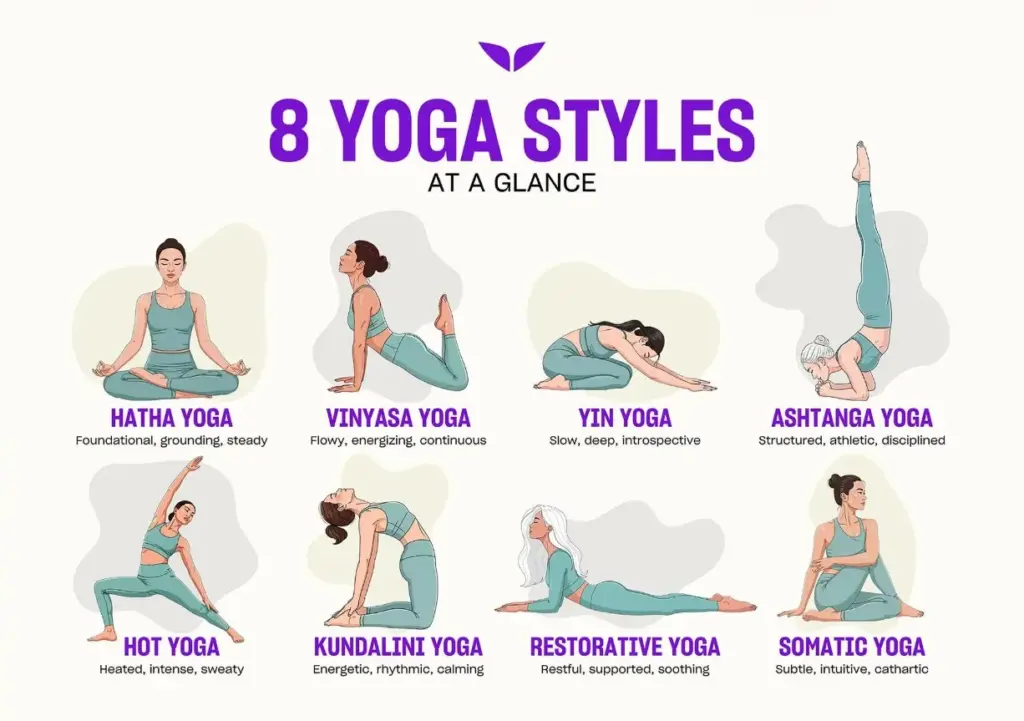
What Are the Different Types of Yoga Styles?
Different yoga styles emphasize different combinations of movement, breathing, alignment, strength, relaxation and meditation. I should choose a style according to my goal, experience level and physical needs rather than choosing one simply because it looks difficult.
Popular styles include:
| Yoga style | Main emphasis | Suitable starting point |
| Hatha | Foundational postures and breathing | Beginners |
| Vinyasa | Breath-linked flowing movement | Beginners with basic fitness |
| Ashtanga | Structured, physically demanding sequence | More experienced practitioners |
| Iyengar | Precision, alignment and props | Beginners and alignment-focused practitioners |
| Yin | Longer passive holds | Flexibility and relaxation |
| Restorative | Supported, gentle poses | Relaxation |
| Kundalini | Breath, movement, meditation and chanting | Those interested in a broader practice |
| Hot Yoga | Yoga practiced in a heated room | Experienced participants who tolerate heat |
There is no universal “best” style.
For example, if my goal is relaxation, a restorative class may make more sense than a highly demanding power class.
If I want a physically active practice, Vinyasa or Ashtanga may be more appropriate.
If I want detailed alignment instruction, Iyengar yoga may be worth exploring.
The Cleveland Clinic similarly notes that different yoga styles can suit different goals, including flexibility, strength, stress relief and relaxation.
– Yoga styles differ in pace, intensity, alignment, breathing, meditation and physical demands. Beginners can start with accessible Hatha, gentle flow, restorative or other beginner-level classes.
What Is Iyengar Yoga and Who Is It Suitable For?
Iyengar yoga is a style that places strong emphasis on alignment, precision, controlled practice and the use of props.
Props can include:
- Yoga blocks
- Belts or straps
- Blankets
- Bolsters
- Chairs
The purpose of props is not to make yoga easier in a negative sense. They can help provide support, improve alignment and make certain postures more accessible.
For example, if I cannot comfortably reach the floor during a standing forward bend, a block can bring the floor closer to my hands instead of forcing my body into an uncomfortable position.
This makes alignment-focused yoga particularly interesting for people who want to understand how a posture is constructed rather than simply moving quickly from one pose to another.
– Iyengar yoga emphasizes precision, alignment, controlled movement and props such as blocks, straps, blankets and bolsters to support the practice.
What Is the Best Time to Do Yoga?
The best time to do yoga is the time I can practice consistently while matching the intensity of the session to my energy, schedule and physical condition.
Morning yoga can work well if I want to start the day with movement, breathing and mental focus.
Evening yoga may be more suitable if my main goal is to release tension and transition into a calmer state.
Current guidance also emphasizes consistency rather than treating one specific clock time as universally superior.
Morning vs evening yoga
| Time | May suit me if I want |
| Early morning | A calm start and consistent routine |
| Late morning | More time for the body to warm up |
| Afternoon | An active practice during a naturally warmer part of the day |
| Evening | Relaxation and stress release |
| Before bed | Gentle stretching, breathing and relaxation |
I should avoid doing vigorous yoga immediately after a heavy meal. If I am practicing after eating, I should allow enough time for digestion and choose an appropriate intensity.
The important lesson for me is simple: a realistic 20-minute practice that I repeat consistently is more useful than an “ideal” schedule that I cannot maintain.
– Morning and evening can both be good times for yoga. Morning may suit an energizing routine, while gentle evening yoga may support relaxation. Consistency is more important than following a rigid time.
How Can I Start Yoga as a Beginner?
I can start yoga without being flexible, athletic or experienced. I only need a safe, manageable starting point.
Here is the approach I would recommend:
Step 1: Decide why I want to practice
My goal could be:
- Better flexibility
- General fitness
- Strength
- Balance
- Stress management
- Relaxation
- Meditation
- Learning traditional yoga
My goal influences the style I choose.
Step 2: Start with a beginner-level class
I should not begin with advanced inversions or extremely demanding sequences just because they look impressive online.
The NCCIH recommends appropriate instruction and cautions beginners against extreme practices.
Step 3: Learn basic movements
I can begin with foundational poses such as:
- Mountain Pose
- Child’s Pose
- Cat-Cow
- Cobra or modified Cobra
- Downward-Facing Dog
- Warrior poses
- Seated forward fold
- Savasana
Step 4: Add breathing awareness
I don’t need complicated breathing techniques immediately.
I can start by noticing whether I am holding my breath and practice slow, comfortable breathing.
Step 5: Practice consistently
I can begin with short sessions and gradually increase duration.
Step 6: Don’t compete with other people
My body may have different proportions, mobility and experience from another person’s body.
Yoga becomes more useful when I focus on awareness rather than comparison.
– Beginners should choose a suitable style, learn foundational poses, practice comfortable breathing, progress gradually and prioritize consistency and safety instead of flexibility or difficult poses.
What Is a Yoga Diet?
A yoga diet generally refers to an approach to eating that supports clarity, moderation, health and mindful living rather than a single standardized diet plan.
There is no universally accepted “yoga diet” that every yoga practitioner must follow.
Traditional yoga philosophy often discusses food in relation to qualities such as sattva, rajas and tamas, although interpretations differ between traditions.
A practical modern approach is to focus on:
- Fresh and minimally processed foods
- Vegetables and fruits
- Whole grains
- Adequate protein
- Nuts and seeds
- Appropriate hydration
- Moderate portions
- Mindful eating
I would not assume that practicing yoga automatically means I must become vegetarian or follow an extremely restrictive diet.
Food requirements depend on my age, activity level, health needs, cultural preferences and nutritional goals.
The broader idea I find useful is mindful eating: paying attention to what I eat, how much I eat and how my food choices affect my energy and practice.
Research reviewed by NCCIH also suggests that yoga participation may be associated with healthier eating and physical-activity habits, although that does not mean yoga itself prescribes one universal diet.
– A yoga diet is generally an eating approach associated with mindful, balanced and supportive food choices. It is not one compulsory diet, and individual nutritional needs still matter.
How Should I Choose Yoga Equipment for My Practice?
I don’t need expensive equipment to begin yoga.
A basic mat and comfortable clothing may be enough for many beginner practices. As I become more experienced, props can make certain practices more comfortable and accessible.
What to consider when buying a yoga bolster
If I decide to buy a bolster, I should consider:
- Shape — Rectangular and cylindrical bolsters provide different types of support.
- Firmness — It should support my body without collapsing excessively.
- Size — The dimensions should suit my body and intended poses.
- Filling — Different fillings affect weight, firmness and comfort.
- Cover — A removable, washable cover is useful.
- Portability — A handle can help if I carry it to classes.
- Purpose — My choice should depend on whether I mainly practice restorative yoga, seated poses, back support or pranayama.
Current yoga equipment guidance similarly highlights shape, firmness, filling, size and intended use when choosing a bolster.
I would not buy a bolster simply because another practitioner uses it. The right prop is the one that supports the practice I actually do.
– When choosing a yoga bolster, I should compare its shape, firmness, size, filling, washable cover, portability and intended use. Rectangular and cylindrical bolsters provide different forms of support.
Frequently Asked Questions About What Yoga Means
What kind of clothing is best for hot yoga sessions?
Breathable, lightweight, sweat-managing clothing that allows unrestricted movement is generally best for hot yoga.
For hot yoga, I would avoid heavy cotton clothing that becomes saturated with sweat and uncomfortable during movement. Fitted but non-restrictive clothing can make it easier to move without constantly adjusting my outfit.
I would also consider the studio’s temperature, my personal comfort and how much I sweat.
Most importantly, hot yoga requires attention to hydration and overheating. The NCCIH specifically notes that hot yoga has additional risks related to overheating and dehydration.
How much do advanced yoga certification courses cost?
There is no single fixed price for an advanced yoga certification course; the cost varies significantly by school, location, duration, format and whether accommodation and meals are included.
Yoga Alliance recognizes different training levels, including RYS 200, RYS 300 and RYS 500. A 300-hour program is generally intended to build on foundational training rather than simply repeat an introductory course.
For example, advertised 300-hour programs in India can vary widely in price depending on whether they are residential, online, international, premium or budget programs.
When I compare courses, I would look beyond the price and check:
- Number of training hours
- Curriculum
- Teacher qualifications
- Accreditation or registration
- Practical teaching experience
- Anatomy and physiology
- Philosophy
- Teaching methodology
- Assessment
- Accommodation and meals
- Certification requirements
A cheap certificate is not necessarily a good certification.
Is yoga only for flexible people?
No. Yoga is not only for flexible people.
I don’t need to touch my toes, perform a split or stand on my head before starting.
In fact, flexibility is something I may develop gradually through appropriate practice.
If I compare myself with an advanced practitioner on social media, yoga can quickly become a competition. If I instead focus on controlled movement, breathing and awareness, I can make the practice appropriate for my current ability.
Is yoga a religion?
Yoga is not simply a religion, although traditional yoga developed within Indian philosophical and spiritual traditions.
Modern yoga can be practiced as physical exercise, mindfulness, meditation, a philosophical discipline or a combination of these.
The important point is that reducing yoga to either “only exercise” or “only religion” misses the complexity of the tradition.
Yoga Alliance also describes yoga as a broad system whose meanings and applications have evolved across different cultures and contexts.
Can I do yoga every day?
Yes, I can practice yoga every day if the intensity is appropriate and my body has enough recovery.
Daily yoga does not mean I need to perform an intense 60-minute workout every day.
For example:
- Monday: Strength-focused yoga
- Tuesday: Gentle mobility
- Wednesday: Breathing and meditation
- Thursday: Vinyasa
- Friday: Restorative yoga
- Saturday: Longer practice
- Sunday: Gentle stretching
The key is to vary intensity and listen to my body.
If I experience persistent pain, dizziness or other concerning symptoms, I should stop and seek appropriate professional advice rather than trying to push through it.
Final Thoughts: What Does Yoga Mean to Me?
To me, yoga means developing a better relationship with my body, breath and mind rather than simply performing impressive poses.
The physical practice matters, but it is only one part of the larger tradition.
When I understand yoga through asana, pranayama, concentration, meditation, philosophy and mindful living, the word becomes much clearer.
I also understand why Patanjali’s definition remains relevant: yoga is fundamentally concerned with developing a steadier relationship with the mind.
So if someone asks me “What does yoga mean?”, my simplest answer is:
Yoga is a traditional Indian discipline that brings together physical practice, breath, awareness, concentration and meditation, with the deeper aim of cultivating mental clarity and inner freedom.
That is why I don’t need to be the most flexible person in the room to practice yoga.
I only need to start where I am and practice with awareness.
Sources and further reading
For a broader introduction to yoga’s history and modern practice, I recommend Yoga Alliance’s guide to what yoga is.
For evidence-based information about yoga’s potential benefits, limitations and safety considerations, see the National Center for Complementary and Integrative Health (NCCIH) yoga overview.
For a current perspective on yoga, healthy ageing and physical and mental well-being, see the World Health Organization’s 2026 yoga overview.
For beginner-friendly practical guidance, Cleveland Clinic’s yoga guide is also useful.
hello mukta