
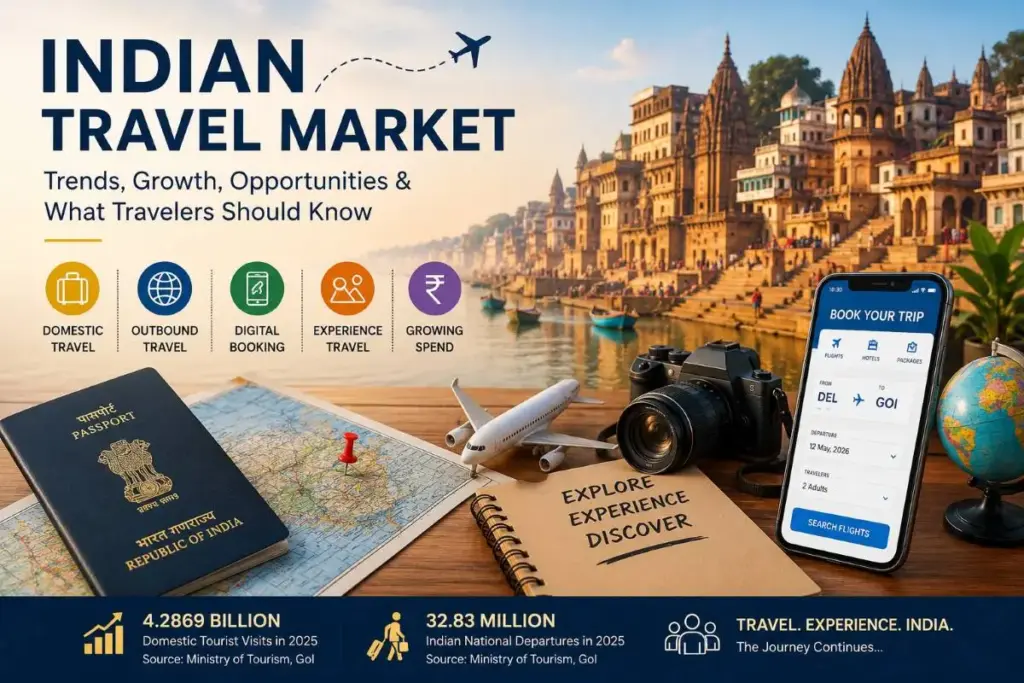
The Indian travel market is changing rapidly as Indians travel more often, explore new destinations, spend more on experiences, and use digital platforms to plan and book their journeys.
When I look at the Indian travel market today, I don’t see a single type of traveler. I see families planning domestic holidays, young travelers looking for experiences, pilgrims traveling to religious destinations, luxury travelers seeking personalized journeys, and Indians increasingly exploring international destinations.
That diversity is what makes the Indian travel market so interesting—and also difficult to understand.
TL;DR
The Indian travel market is being shaped mainly by domestic tourism, outbound travel, digital booking, experiential tourism, luxury travel and growing demand from travelers outside India’s biggest cities.
India recorded 4.2869 billion domestic tourist visits in 2025, while Indian national departures reached 32.83 million. These figures show the enormous scale of travel demand in the country.
At the same time, travel planning has become increasingly digital. Travelers can compare flights, hotels, reviews and prices before making a booking, while digital payments such as UPI have made transactions much easier.
For me, the biggest change is simple: Indian travelers are not only traveling more; they are becoming more informed about how, where and why they travel.
What Is the Indian Travel Market?
The Indian travel market includes the businesses, travelers, destinations and services involved in domestic, inbound and outbound travel.
I look at it through four broad categories:
| Market | What it means |
| Domestic travel | Indians traveling within India |
| Outbound travel | Indians traveling to other countries |
| Inbound travel | Foreign travelers visiting India |
| Experience-led travel | Travel built around food, wellness, adventure, spirituality, wildlife, culture or luxury |
Domestic tourism is the largest part of the market by travel volume.
According to India’s Ministry of Tourism, the country recorded 4,286.90 million domestic tourist visits in 2025. Indian national departures stood at 32.83 million during the same year.
One thing I always clarify when discussing these numbers is that a “tourist visit” is not the same as a unique traveler. One person can make several domestic tourist visits in a year.
That distinction prevents us from misunderstanding the actual size of India’s traveler population.
Why is the Indian travel market growing?
Several factors are contributing to the growth:
- improving road, rail and air connectivity
- increasing disposable income
- easier online booking
- digital payments
- growing travel awareness
- better access to travel information
- increasing interest in experiences
- more international travel options
- growing demand from Tier-II and Tier-III cities
The Indian travel market covers domestic, inbound, outbound and experience-led tourism. Domestic travel creates the largest volume, while international and specialized travel segments are creating new commercial opportunities.
This article explores the Best Himachal Pradesh travel places, from scenic destinations to lesser-known hidden gems. It helps travelers discover where to go in Himachal Pradesh and choose destinations based on their travel interests.
What Are the Current Growth Segments in India’s Domestic Travel Market?
The domestic travel market is no longer limited to traditional sightseeing holidays.
I see several segments gaining importance because travelers are becoming more specific about what they want from a trip.
Spiritual tourism
Spiritual travel remains one of India’s strongest tourism categories.
Travelers visit destinations such as Varanasi, Ayodhya, Tirupati, Amritsar and numerous pilgrimage centers throughout the country.
Government programs such as PRASHAD have also focused on developing pilgrimage and heritage destinations.
For travelers, better infrastructure can make these journeys more convenient and accessible.
Wellness tourism
Wellness travel is another important opportunity.
Travelers are increasingly looking for:
- yoga retreats
- Ayurveda
- meditation
- nature retreats
- wellness resorts
- relaxation-focused holidays
Instead of taking a holiday simply to visit attractions, some travelers now choose destinations specifically to disconnect and recharge.
Adventure tourism
Trekking, rafting, camping, skiing, scuba diving and other outdoor activities are attracting travelers who want experiences rather than conventional sightseeing.
This is particularly relevant to younger travelers who often discover destinations through digital content and social media.
Wildlife and nature tourism
Wildlife tourism allows travelers to combine travel with nature and conservation.
However, I believe responsible tourism should remain a priority here. A good wildlife experience should respect animals, local communities and the environment.
Short domestic breaks
Not every traveler has the time or budget for a two-week holiday.
Short trips of two to four days can therefore create significant demand.
A nearby hill station, heritage city, beach destination or wildlife park can become an attractive weekend option.
India’s domestic travel growth is being supported by spiritual, wellness, adventure, wildlife, experiential and short-break tourism. Travelers increasingly choose trips according to purpose rather than simply choosing a destination.
What Are the Emerging Trends in the Indian Travel Market?
The most important trend I see is greater segmentation.
There is no single “Indian traveler.”
A young solo traveler from Bengaluru can have completely different expectations from a multigenerational family traveling from a smaller city.
Travel planning is becoming digital
Travelers can now research almost everything before booking:
- destinations
- hotels
- flights
- reviews
- activities
- prices
- travel videos
- restaurants
- visa requirements
EY’s research found that 69% of travelers prefer online aggregators for booking, showing how important digital channels have become.
Experiences are replacing generic sightseeing
Travelers increasingly ask:
“What can I experience there?”
rather than only:
“What can I see there?”
This has created demand for:
- food tours
- cooking classes
- wildlife safaris
- village experiences
- heritage walks
- adventure activities
- wellness retreats
- luxury train journeys
Smaller cities are becoming important
Travel demand is spreading beyond India’s largest metropolitan areas.
This creates opportunities for businesses that understand the specific requirements of travelers from smaller cities, including language, payment preferences, family travel and international documentation.
Luxury is becoming more personalized
Indian luxury travel is also changing.
A luxury traveler may want privacy, personalized service, exclusive experiences and carefully designed itineraries rather than simply an expensive hotel room.
Outbound travel is becoming more sophisticated
Indian travelers planning international holidays are increasingly comparing destinations based on:
- visa requirements
- flight connectivity
- total cost
- experiences
- accommodation
- safety
- convenience
The emerging Indian travel market is digital, experience-led and increasingly personalized. Travelers are becoming more selective about destinations, products and the overall value they receive.
How Are Indians Booking and Paying for Travel?
Digital booking has changed the way Indians purchase travel.
I can now compare a flight, hotel or holiday package without visiting a physical travel agency.
Online travel aggregators, airline websites, hotel platforms and direct booking channels all compete for the same customer.
Which payment solutions do Indian travelers prefer?
UPI has become particularly important for domestic digital transactions, while credit cards, debit cards and net banking remain relevant for larger bookings.
A travel website should ideally provide:
- UPI
- credit cards
- debit cards
- net banking
- secure payment gateways
- EMI options where relevant
NPCI’s UPI One World initiative has also made it possible for eligible international visitors to use UPI for certain merchant payments in India.
For me, payment is part of the customer experience.
If a traveler has already decided to buy a holiday, complicated payment procedures can create unnecessary friction.
Why do digital payments matter to travel businesses?
Travel purchases can involve significant amounts of money.
Customers want to know:
- exactly what they are paying for
- whether taxes are included
- what happens if they cancel
- when refunds will be processed
- whether payment is secure
Digital booking and payments are now central to the Indian travel market. UPI, cards and other convenient payment options help reduce friction, while transparent pricing and refund policies build customer confidence.
How Can Indians Plan International Travel More Easily?
International travel becomes much easier when I separate three concepts: visa-free travel, visa on arrival and e-visa.
What does visa-free travel mean?
Visa-free travel generally means an eligible traveler can enter a destination without obtaining a traditional visa beforehand.
What is visa-on-arrival travel?
With a visa on arrival, the traveler generally receives the visa after reaching the destination, subject to that country’s conditions.
What is an e-visa?
An e-visa requires the traveler to complete an online application before traveling.
The Ministry of External Affairs provides official information on visa facilities available to Indian ordinary passport holders.
This is particularly important if you’re searching for indian can travel without a visa or travel without a visa for an Indian passport.
I would never depend entirely on an old “visa-free countries” list found online.
Before booking, I check:
- passport validity
- permitted duration of stay
- return-ticket requirements
- accommodation requirements
- immigration forms
- travel insurance
- latest entry conditions
Indians can access several destinations through visa-free, visa-on-arrival or e-visa arrangements, but the conditions vary. I always recommend checking current official requirements before booking an international trip.
How Do Indian Luxury Travel and Indian Luxury Train Travel Fit Into the Market?
Indian luxury travel is moving beyond expensive accommodation.
Today, luxury can mean:
- privacy
- personalization
- premium transportation
- fine dining
- heritage
- wellness
- exclusive experiences
- customized itineraries
This is where Indian luxury train travel becomes particularly interesting.
A luxury train can combine transportation, accommodation, dining, sightseeing and personalized service into one experience.
Instead of treating transportation as a necessary part of the holiday, the journey itself becomes part of the attraction.
For me, this represents a broader shift in luxury tourism: travelers increasingly pay for time, convenience and memorable experiences, not simply expensive products.
Indian luxury travel is becoming experience-led, while luxury train travel turns the journey itself into part of the premium experience.
How Important Are Indian Food and Travel Experiences?
Food is one of the easiest ways to understand India’s cultural diversity.
I don’t think food should be treated as an afterthought when planning a trip.
A traveler visiting Lucknow may want to explore its kebabs. Someone visiting Hyderabad may plan around biryani. A trip to Kerala can involve regional seafood, while Kolkata can become a destination for sweets and Bengali cuisine.
This is where Indian travel food ideas become useful.
What can food-focused travel include?
Local markets
Markets can provide a more authentic view of how people eat and shop.
Regional specialties
I prefer focusing on dishes genuinely associated with the destination instead of generic restaurant menus.
Cooking experiences
Cooking classes can turn food into a cultural experience.
Food walks
A good food walk can combine cuisine with local history and culture.
This is why Indian food and travel naturally overlap.
Food tourism makes regional cuisine part of the travel experience itself. Local dishes, markets, cooking classes and food walks can influence destination choice and make a trip more memorable.
How Has Digital Transformation Changed Traditional Travel Agents in India?
Digital transformation has not necessarily eliminated travel agents.
It has changed their role.
If I can book a flight in two minutes, a travel agent cannot compete simply by providing access to the same flight.
The value now comes from expertise.
An Indian travel expert can provide significant value when a trip involves:
- multiple destinations
- complicated itineraries
- visa requirements
- large families
- luxury travel
- elderly travelers
- corporate travel
- last-minute changes
- emergency support
This means traditional agents have an opportunity to reposition themselves as advisors rather than transaction providers.
Digital transformation has reduced the need for basic booking assistance but increased the value of specialized travel advice, itinerary planning and customer support.
How Should You Choose an Indian Travel Operator?
When I evaluate a travel operator, I don’t start with the cheapest package. I start by asking what I am actually getting for the money.
Check the complete package
I look for:
- hotel details
- transportation
- airport transfers
- meals
- sightseeing
- entry tickets
- taxes
- guide charges
- permits
Read the cancellation policy
I want to know exactly how much money I can recover if my plans change.
Check independent reviews
I don’t rely only on testimonials published by the company.
I look for repeated patterns in customer reviews.
Get important promises in writing
If someone tells me that a particular hotel, transfer or activity is included, I want it mentioned in the quotation or booking confirmation.
Check emergency support
This becomes especially important for international trips, remote destinations, adventure travel and family holidays.
Choose a travel operator based on transparency, inclusions, cancellation terms, accommodation, reviews, communication and emergency support—not simply the cheapest price.
What Government Initiatives Are Shaping Indian Tourism?
Government policy is increasingly focused on developing destinations rather than concentrating tourism only around India’s most famous attractions.
Important initiatives include:
- Swadesh Darshan
- Swadesh Darshan 2.0
- PRASHAD
- rural tourism initiatives
- rural homestay promotion
- sustainable tourism
- destination development
Swadesh Darshan 2.0 places greater emphasis on sustainable and responsible tourism and destination development.
The National Strategy and Roadmap for Rural Tourism also focuses on areas such as rural tourism clusters, digital technology, marketing and capacity building.
These initiatives matter because tourism can create opportunities for local businesses, homestays, guides, artisans, restaurants and transportation providers.
Indian tourism policy is increasingly supporting destination development, spiritual tourism, rural tourism, sustainability and local participation instead of focusing only on traditional tourist centers.
How Should I Use an Indian Travel Guide Before Booking a Trip?
A good Indian travel guide should help me make decisions, not simply provide a list of attractions.
I use five basic questions.
1. Why am I traveling?
Is the trip for relaxation, adventure, food, spirituality, wildlife, wellness, culture or luxury?
2. When should I travel?
I check weather, local events, crowds and destination-specific conditions.
3. What is my complete budget?
I calculate transportation, accommodation, food, activities, local travel and contingency expenses.
4. Do I need a travel operator?
For a simple domestic trip, I may book independently.
For complicated international or luxury travel, professional assistance can be worthwhile.
5. What should I verify before leaving?
I check booking confirmations, identification documents, visa requirements, weather conditions and relevant government advisories.
A useful Indian travel guide should help travelers make decisions about destination, timing, budget, transportation, accommodation, experiences and safety rather than simply listing tourist attractions.
What Should an Indian Travel Expert Check Before Recommending a Destination?
A destination recommendation should go beyond saying that a place is beautiful.
I would consider:
- seasonality
- accessibility
- total travel cost
- safety
- accommodation
- local transportation
- activities
- traveler profile
- visa requirements for international destinations
- current government advisories
A travel advisory by the Indian government can be useful when assessing international travel risks, but I would not use it as the only source.
I would also check the relevant destination’s official government or immigration information.
An Indian travel expert should combine destination knowledge with current information on safety, entry requirements, seasonality, costs and accessibility before recommending a destination.
This article shares my experience of planning a Kashmir trip, including important travel considerations, destination choices, planning decisions, and practical insights for travelers.
Frequently Asked Questions About the Indian Travel Market
What are the biggest Indian travel market trends?
The biggest trends are domestic tourism growth, digital booking, experiential travel, luxury tourism, spiritual travel, wellness, wildlife tourism and increasing outbound travel.
The biggest change I notice is that travelers increasingly choose trips according to the experience they want rather than simply selecting a famous destination.
Can Indian passport holders travel without a visa?
Yes, Indian passport holders can enter several destinations without obtaining a traditional visa in advance, subject to the rules of each destination.
I would always verify the latest requirements with the relevant official authority because visa policies can change.
What is the difference between visa-free and visa-on-arrival travel for Indians?
Visa-free travel generally does not require a traditional visa before entry, while visa-on-arrival means the traveler obtains the visa after reaching the destination.
Both can still involve conditions such as passport validity, return tickets and permitted stay.
Which payment method is best for Indian travel bookings?
UPI is highly convenient for many domestic bookings, while credit and debit cards are also important for larger and international transactions.
I would choose the payment method based on security, convenience, refund conditions and applicable benefits.
Is domestic travel more important than outbound travel in India?
Domestic travel is much larger by reported travel volume, while outbound travel is an important growing segment.
India recorded 4.2869 billion domestic tourist visits and 32.83 million Indian national departures in 2025.
How do I choose a reliable Indian travel operator?
Compare the complete package, cancellation policy, hotel details, transportation, reviews, payment terms and customer support before booking.
I would never choose an operator only because its initial quotation is the cheapest.
Why is luxury travel growing in India?
Luxury travel is growing because travelers increasingly want personalized experiences, convenience, privacy and premium services.
For me, modern luxury is about the quality and personalization of the entire journey rather than simply choosing the most expensive hotel.
What role does food play in Indian tourism?
Food can influence destination choice and become a central part of the travel experience.
Regional cuisine, food walks, markets and cooking experiences allow travelers to understand a destination through its culture and traditions.
Final Thoughts on the Indian Travel Market
The Indian travel market is becoming larger, more digital and more specialized.
But I don’t think the most useful way to understand it is simply by asking how many Indians are traveling.
I would ask better questions:
Why are they traveling?
What are they willing to spend on?
How are they booking?
Which experiences do they value?
What makes them choose one destination over another?
The answers reveal where the market is heading.
Domestic tourism will continue to provide enormous volume, while outbound travel will create opportunities for international destinations and premium travel businesses. Digital platforms will influence discovery and booking, while specialized experiences will become increasingly important.
For me, the defining characteristic of the modern Indian travel market is the rise of the informed traveler.
Indians are researching more, comparing more and expecting more.
Travel businesses that understand this shift—and build products around specific traveler needs rather than generic packages—will be better positioned for the next phase of India’s travel industry.