
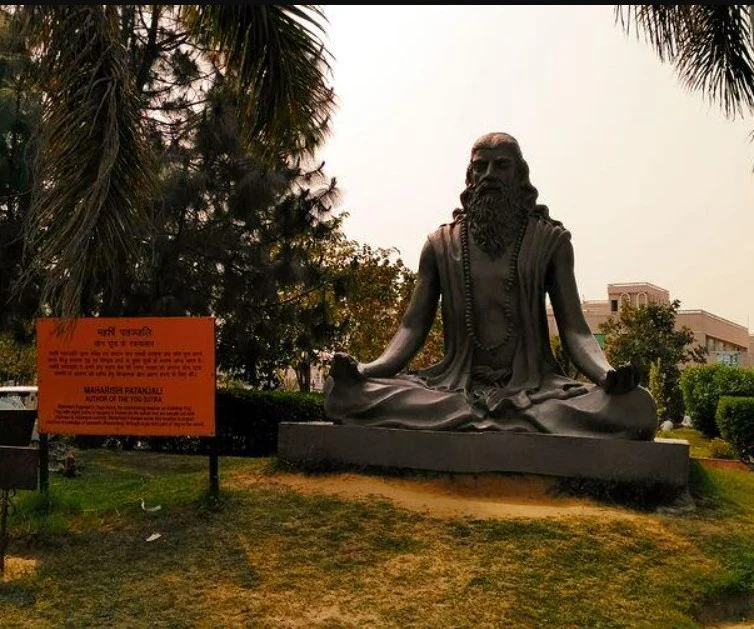
Patanjali Maharishi is one of the most important figures associated with classical Yoga. He is traditionally regarded as the author of the Yoga Sutras, a foundational text that explains Yoga as a discipline of the mind, ethical living, concentration, meditation and liberation. Patanjali did not invent Yoga from nothing; instead, he systematized important ideas from an older Yoga tradition.
When I first look at Patanjali, it is easy to connect his name only with Yoga poses. However, his teachings go much deeper than physical exercise. The Yoga Sutras focus heavily on the mind, mental discipline, meditation, consciousness and the path toward liberation.
Patanjali Maharishi was an ancient Indian sage traditionally associated with the Yoga Sutras of Patanjali. The exact details of his life, date and historical identity remain uncertain.
The Yoga Sutras present a systematic philosophy of Yoga and explain important concepts such as mental discipline, practice, detachment, the eight limbs of Yoga, concentration, meditation, samadhi and kaivalya.
I would describe Patanjali as a systematizer of classical Yoga rather than the inventor of Yoga. Yoga traditions existed before the Yoga Sutras, but the text associated with Patanjali became one of the most influential works for understanding classical Yoga.
Who Is Patanjali Maharishi and What Is He Known For?
Patanjali Maharishi is traditionally revered as an ancient Indian sage associated with the Yoga Sutras, one of the foundational texts of classical Yoga.
When I ask, “Who is Patanjali Maharishi?”, the simplest answer is that he is the figure traditionally associated with one of India’s most influential systems of Yoga philosophy.
His importance comes from the Yoga Sutras rather than from a detailed historical biography. Reliable historical information about his personal life is limited, so I would avoid presenting popular stories about his birth, family or exact life as established historical facts.
The Yoga Sutras explain Yoga through ideas such as controlling mental fluctuations, disciplined practice, detachment, ethical behavior, concentration, meditation and liberation.
This also helps me understand why classical Yoga is much broader than modern physical exercise.
UNESCO recognizes Yoga as an element of India’s intangible cultural heritage and describes it as a practice involving physical postures, meditation, controlled breathing and other techniques connected with self-realization and liberation. (UNESCO)
Patanjali Maharishi is important because the Yoga Sutras traditionally associated with him provide a systematic presentation of classical Yoga philosophy, practice and the path toward liberation.
Who Was Patanjali in Ancient India?
The question “who was Patanjali in ancient India?” is more complicated than it first appears.
Traditional Indian accounts describe Patanjali as a respected sage and teacher. However, historical evidence does not provide enough information to establish a complete biography.
Another important source of confusion comes from the name Patanjali.
A famous Sanskrit grammarian named Patanjali is traditionally associated with the Mahabhashya, an important work connected with the grammatical tradition of Panini. Scholars have debated whether this Patanjali and the author of the Yoga Sutras were actually the same person.
I would therefore be careful with websites that confidently state that one person definitely wrote the Yoga Sutras, Mahabhashya and works on Ayurveda.
What I can say with greater confidence is that Patanjali became strongly associated with the classical Yoga tradition through the Yoga Sutras.
Patanjali was traditionally regarded as a great Indian sage, but the historical evidence does not provide a complete and certain biography of him.
Who Was Patanjali in History and When Did He Live?
The exact date of Patanjali is uncertain.
Scholars have proposed different dates for the composition of the Yoga Sutras, and the text itself does not provide enough evidence to establish a precise historical date.
For this reason, I would avoid giving one exact year for Patanjali’s life as though historians have reached a final agreement.
The authorship question also makes his history more complicated. The Patanjali associated with Sanskrit grammar and the Patanjali associated with the Yoga Sutras have traditionally been connected, but their identification remains debated.
This distinction is important because historical research and traditional accounts do not always answer the same questions.
Traditional accounts may preserve cultural and spiritual memories, while historical scholarship examines textual evidence, chronology and authorship.
Patanjali’s exact historical identity and date remain uncertain, so I distinguish traditional accounts from what historical and textual evidence can establish.
Who Wrote Patanjali Yoga Sutra?
The Yoga Sutras are traditionally attributed to Patañjali.
The text consists of short philosophical statements called sutras. These statements are organized into four sections, commonly known as padas.
| Chapter | Sanskrit name | Main focus |
| 1 | Samadhi Pada | Yoga, concentration and samadhi |
| 2 | Sadhana Pada | Practice, obstacles and the eight limbs |
| 3 | Vibhuti Pada | Concentration, meditation and extraordinary attainments |
| 4 | Kaivalya Pada | Liberation and consciousness |
The text is commonly counted as 195 or 196 sutras, depending on the textual tradition and method of counting.
One of its most famous statements appears in Yoga Sutra 1.2:
“Yogaś citta-vṛtti-nirodhaḥ.”
It is commonly understood as describing Yoga in terms of stilling or restraining the fluctuations of the mind.
For me, this statement immediately changes the way I understand Patanjali. Yoga is not simply about stretching the body. It is fundamentally concerned with the mind and consciousness.
The Yoga Sutras are traditionally attributed to Patanjali and present Yoga as a systematic discipline involving mental control, concentration, meditation and liberation.
What Is Patanjali’s Definition of Yoga?
Patanjali’s definition of Yoga appears at the beginning of the Yoga Sutras.
The Sanskrit phrase “Yogaś citta-vṛtti-nirodhaḥ” is commonly translated as the restraint, stilling or cessation of the fluctuations of the mind.
In simple language, I can understand this as learning not to be completely controlled by every thought, emotion, reaction or mental distraction that appears.
For example, imagine that I receive criticism at work.
My first reaction might be anger.
I may immediately start thinking about what the other person said, why they said it and how I should respond.
Patanjali’s approach encourages me to develop enough mental awareness to observe the reaction instead of automatically becoming controlled by it.
This does not mean that Yoga requires me to stop thinking permanently.
Rather, classical Yoga focuses on developing mastery over mental activity.
According to Patanjali, Yoga is fundamentally concerned with disciplining and stilling the fluctuations of the mind rather than simply performing physical postures.
What Are the Main Teachings of Patanjali’s Yoga Sutras?
The main teachings of Patanjali’s Yoga Sutras include practice, detachment, ethical discipline, concentration, meditation and liberation.
Two important concepts are abhyasa and vairagya.
Abhyasa means sustained practice, while vairagya refers broadly to detachment or dispassion.
I find this combination useful because practice without detachment can become frustrating.
For example, if I meditate every day but constantly expect immediate results, I may become disappointed.
Practice asks me to continue.
Detachment reminds me not to become obsessed with the result.
Patanjali also discusses the five kleshas, which are commonly understood as causes or sources of suffering:
- Avidya – ignorance
- Asmita – ego-identification
- Raga – attachment
- Dvesha – aversion
- Abhinivesha – clinging to life
These ideas remain understandable even in modern life.
If I become excessively attached to success, failure can disturb me deeply. If I strongly dislike something, my reaction may become stronger than the situation itself.
Patanjali’s philosophy encourages me to examine these patterns rather than automatically follow them.
Patanjali’s main teachings focus on disciplined practice, detachment, ethical behavior, concentration, meditation and understanding the mental patterns that contribute to suffering.
What Are the Eight Limbs of Patanjali’s Yoga?
Patanjali’s Ashtanga Yoga means the eight-limbed path of Yoga.
The eight limbs are:
| No. | Limb | Simple meaning |
| 1 | Yama | Ethical restraints |
| 2 | Niyama | Personal observances |
| 3 | Asana | Posture |
| 4 | Pranayama | Regulation of breath |
| 5 | Pratyahara | Withdrawal of the senses |
| 6 | Dharana | Concentration |
| 7 | Dhyana | Meditation |
| 8 | Samadhi | Deep meditative absorption |
These eight limbs show why Patanjali’s Yoga cannot be reduced to physical exercise.
Asana is only one of the eight limbs.
The system begins with ethical and personal discipline and progresses toward deeper concentration and meditation.
Is Patanjali’s Ashtanga Yoga the Same as Modern Ashtanga Yoga?
No.
Patanjali’s Ashtanga Yoga refers to the eight limbs of Yoga.
Modern Ashtanga Vinyasa Yoga is a later physical Yoga tradition involving structured sequences of postures.
The similarity in terminology can create confusion, but the two should not automatically be treated as the same system.
Patanjali’s Ashtanga Yoga is an eight-limbed philosophical and practical system, whereas modern Ashtanga Vinyasa is a later style of physical Yoga practice.
What Is the Philosophy Behind Patanjali Maharishi’s Yoga?
Patanjali’s philosophy is closely connected with the concepts of Purusha and Prakriti.
In simple terms, Purusha refers to consciousness, while Prakriti refers to material nature and its changing processes.
Patanjali’s Yoga philosophy also examines why human beings experience suffering and how greater discrimination and awareness can lead toward liberation.
This gives me a different perspective on Yoga.
If I think every thought or emotion defines who I am, I may become trapped by constantly changing mental experiences.
Classical Yoga encourages me to observe these experiences and develop a clearer understanding of consciousness.
The ultimate goal is kaivalya, generally understood as liberation.
This is why I would not describe Patanjali’s Yoga simply as a method for improving flexibility.
Its philosophical goal goes much deeper.
Patanjali’s philosophy examines consciousness, mental activity, suffering and liberation, with kaivalya representing the ultimate goal of the classical Yoga system.
How Has Patanjali Influenced Modern Yoga?
Patanjali’s influence is particularly important in the philosophical understanding of Yoga.
Modern Yoga classes often focus on physical postures, flexibility, balance and strength. These practices are now an important part of global Yoga culture, but Patanjali’s system presents Yoga as much broader.
I can understand the eight limbs through everyday life:
- Yama: how I behave toward others
- Niyama: how I discipline myself
- Asana: how I develop physical steadiness
- Pranayama: how I work with the breath
- Pratyahara: how I manage sensory distractions
- Dharana: how I train concentration
- Dhyana: how I practice meditation
- Samadhi: deeper meditative absorption
This perspective helps me understand why the philosophy of Yoga can continue to influence people even when they are not practicing advanced physical postures.
Patanjali influenced modern Yoga by providing a philosophical framework that connects ethical living, physical practice, breath awareness, concentration, meditation and deeper states of consciousness.
Why Is Patanjali Important to Yoga?
Patanjali is important because the Yoga Sutras provide a systematic presentation of classical Yoga philosophy and practice.
I would not say that Patanjali created Yoga.
Yoga developed through older Indian traditions and multiple philosophical and spiritual streams.
Instead, Patanjali’s importance comes from the systematic framework associated with the Yoga Sutras.
The text gives me a way to understand Yoga through several connected dimensions:
- Ethical behavior
- Personal discipline
- Physical steadiness
- Breath regulation
- Sensory control
- Concentration
- Meditation
- Samadhi
This is also why the question “who was Patanjali and why is he important to Yoga?” cannot be answered simply by calling him an ancient Yoga teacher.
His importance comes from the enduring influence of the philosophical system associated with his name.
Patanjali is important to Yoga because the Yoga Sutras became a major systematic expression of classical Yoga philosophy and continue to influence how Yoga is studied and understood.
“Patanjali’s teachings provide an important foundation for understanding yoga, while Hatha Yoga offers a more practical approach through physical postures, breathing, and other practices.”
Is Patanjali Maharishi a Historical or Legendary Figure?
Patanjali is a traditionally revered sage, but the precise historical details of his life remain uncertain.
The Yoga Sutras are traditionally attributed to him, but scholars continue to discuss the text’s date and the identity of its author.
I think it is important to distinguish historical evidence from traditional stories.
Traditional accounts have cultural and spiritual value, but they should not automatically be presented as historical facts.
I can respect Patanjali’s traditional status while also acknowledging that we do not have a complete historical biography of him.
Patanjali’s traditional identity as a Maharishi is deeply established in Yoga culture, while his exact historical biography and identity remain subjects of scholarly discussion.
What Is the Significance of Patanjali’s Yoga in Daily Life?
I can understand Patanjali’s Yoga as more than something I practice on a Yoga mat.
The eight limbs provide a way to think about how I behave, how I manage my attention and how I relate to my thoughts.
For example, constant phone notifications can make concentration difficult.
If I cannot spend even ten minutes on one task without checking my phone, the problem may not be a lack of knowledge. I may need to develop better control over my attention.
Patanjali’s emphasis on dharana, or concentration, gives me a useful way to understand this problem.
Similarly, yama and niyama remind me that Yoga involves behavior and discipline, not only physical movement.
The significance of Patanjali’s Yoga in daily life lies in its broader approach to ethical behavior, self-discipline, attention, breath awareness, concentration and meditation.
Frequently Asked Questions About Patanjali Maharishi
Who is Patanjali and what is Yoga?
Patanjali is the sage traditionally associated with the Yoga Sutras, while Yoga is a broader Indian philosophical and spiritual tradition involving discipline, meditation, ethical conduct, physical practices and the pursuit of liberation.
I would not define Yoga simply as stretching because classical Yoga gives major importance to the mind and consciousness.
Who was Patanjali in ancient India?
Patanjali was traditionally regarded as a respected Indian sage associated with Yoga philosophy.
However, historical evidence does not provide a complete biography, so I would separate traditional descriptions from historically established facts.
Who was Patanjali in history?
Patanjali is historically associated with the Yoga Sutras, but his exact identity and date remain uncertain.
The question becomes more complicated because another Patanjali is associated with the Sanskrit grammatical work Mahabhashya.
Who was Patanjali and why is he important to Yoga?
Patanjali is important because the Yoga Sutras provide a systematic presentation of classical Yoga philosophy and practice.
His teachings help me understand Yoga as something much broader than physical exercise.
Who wrote Patanjali Yoga Sutra?
The Yoga Sutras are traditionally attributed to Patañjali.
However, the exact historical identity and date of the author remain subjects of scholarly discussion.
Did Patanjali invent Yoga?
No, Patanjali did not invent Yoga from nothing.
Yoga traditions existed before him. His major contribution was the systematic presentation of important Yoga ideas through the Yoga Sutras.
Is Patanjali the same person who wrote the Mahabhashya?
It is uncertain whether they were the same person.
The association has existed in traditional scholarship, but modern scholars continue to debate the identification.
What are Patanjali’s eight limbs of Yoga?
The eight limbs are yama, niyama, asana, pranayama, pratyahara, dharana, dhyana and samadhi.
Together they describe an eight-limbed path progressing from ethical and personal discipline toward concentration, meditation and deeper states of awareness.
What is Patanjali’s most important teaching?
One of Patanjali’s central teachings is that Yoga involves stilling the fluctuations of the mind.
This helps explain why concentration and meditation are so important in classical Yoga.
What is the difference between Patanjali Yoga and modern Yoga?
Patanjali’s classical Yoga is a broader philosophical system, while much modern Yoga focuses heavily on physical postures and movement.
Modern Yoga can include many elements that are not the primary focus of the Yoga Sutras, so I should not automatically treat today’s studio practice as identical to Patanjali’s classical system.
Final Thoughts
When I ask “what is and who is Patanjali Maharishi?”, I find that the answer goes much deeper than simply saying that he was an ancient Yoga teacher.
Patanjali is traditionally associated with the Yoga Sutras, a foundational text of classical Yoga.
His exact historical biography remains uncertain, but his philosophical influence is much clearer.
The biggest misconception I would avoid is saying that Patanjali invented Yoga.
Yoga existed before the Yoga Sutras, while Patanjali’s importance comes from the systematic framework associated with his teachings.
For me, the most valuable lesson is that Yoga is not limited to physical postures.
It also concerns how I behave, how I manage my attention, how I understand my mental patterns and how I develop deeper awareness.
That broader understanding is what makes Patanjali Maharishi relevant when I want to understand what Yoga really means beyond exercise.