
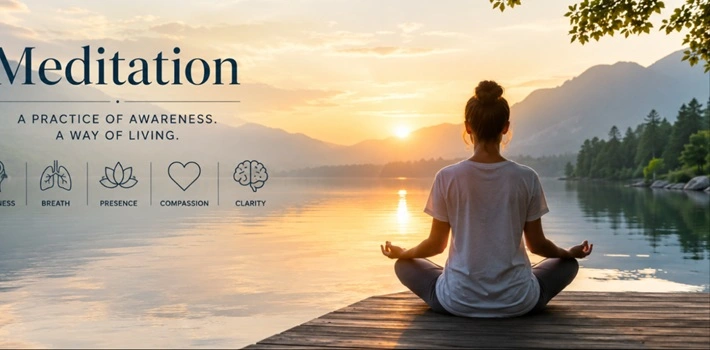
What is meditation definition? Meditation is the practice of intentionally training my attention and awareness so I can observe my thoughts, emotions, breathing and sensations without automatically reacting to them. I do not need to stop thinking or empty my mind to meditate.
Meditation is a simple mental practice that I can use to develop attention, awareness and a calmer relationship with my thoughts. I can begin with just five minutes, using my natural breathing as a focus. There are several types of meditation, including mindfulness, breathing, focused-attention, mantra and guided meditation. Meditation may support stress management, sleep, concentration and emotional well-being, although it is not a replacement for professional medical care.
What is meditation explained simply?
I define meditation as deliberately paying attention to the present moment and training my mind to return to that attention whenever it wanders.
For example, I can sit comfortably and focus on my breathing.
After a few seconds, I may start thinking about work, money, family or tomorrow’s plans.
Instead of following those thoughts, I notice that my attention has wandered and gently return to my breathing.
That process is meditation.
Meditation does not mean having a completely empty mind.
It also does not require a particular religion, expensive equipment or a special sitting position.
Modern mindfulness practices commonly involve paying attention to present-moment experiences with an accepting, non-judgmental attitude. American Psychological Association – Mindfulness Meditation
Meditation is intentional attention training. I choose a focus, notice when my mind wanders and repeatedly bring my attention back.
What Is Meditation? Truth About Ancient Meditation and How Does It Work?
Meditation has ancient roots and has been practiced in different forms across religious and philosophical traditions for thousands of years.
Today, meditation is also practiced in secular settings for purposes such as mindfulness, relaxation, stress management and self-awareness.
The important point is that meditation is not one single technique.
Different meditation practices use different objects of attention and different methods.
The basic process can be understood as:
Focus → Notice → Return → Repeat
When I focus on my breathing, for example, I am training myself to recognize distraction and return my attention to the present experience.
Research has examined meditation and mindfulness for stress, anxiety, depression symptoms, sleep and other outcomes, although the strength of evidence differs depending on the technique and the condition being studied. NCCIH – Meditation and Mindfulness
Meditation has ancient origins but is also studied today as a mental practice. Its basic mechanism involves intentionally directing attention and returning it when distraction occurs.
What are the core principles of meditation?
I find five principles particularly useful when learning meditation.
1. Attention
I deliberately choose where to place my attention.
My breathing is one of the easiest starting points.
2. Awareness
I notice what is happening in my mind and body instead of operating automatically.
3. Non-judgment
I notice thoughts without constantly labeling them as good or bad.
4. Acceptance
I acknowledge what I am experiencing instead of immediately fighting against it.
5. Returning
When my mind wanders, I return to my chosen focus.
This last step is especially important for beginners.
If my mind wanders 20 times and I return 20 times, I have not failed 20 times.
I have practiced returning my attention 20 times.
– Meditation develops intentional attention, awareness, acceptance and non-judgment. The repeated act of returning attention is a central part of the practice.
What are the different types of meditation techniques?
I do not need to use the same meditation technique as another person.
The right technique depends on my purpose and what feels practical for me.
| Type of meditation | What I focus on | Suitable for |
| Mindfulness meditation | Present thoughts, feelings and sensations | Awareness |
| Breathing meditation | Natural breathing | Beginners |
| Focused-attention meditation | One selected object | Concentration |
| Mantra meditation | Repeated word or phrase | Focus |
| Body scan | Physical sensations | Body awareness |
| Loving-kindness meditation | Compassion and goodwill | Emotional awareness |
| Guided meditation | Instructor’s instructions | Beginners who need structure |
| Walking meditation | Movement and physical sensations | People who dislike sitting |
I would choose one method and practice it consistently instead of constantly changing techniques.
Meditation includes several techniques, including mindfulness, breathing, focused attention, mantra, body scan, loving-kindness, guided and walking meditation.
How do I start a meditation practice as a beginner?
I do not need to begin with 30 or 60 minutes.
I can start with five minutes a day.
My simple beginner meditation guide
Step 1: Choose a comfortable place.
I sit somewhere where I can remain undisturbed for a few minutes.
Step 2: Choose a comfortable position.
I can sit on a chair, cushion or floor.
I do not need to sit cross-legged.
Step 3: Set a five-minute timer.
A short session makes the habit easier to maintain.
Step 4: Focus on my natural breathing.
I notice the inhale and exhale without forcing my breathing.
Step 5: Notice when my mind wanders.
I may think about work, food, relationships, money or tomorrow’s tasks.
That is normal.
Step 6: Return to my breathing.
I gently bring my attention back.
Step 7: Finish without judging myself.
I do not measure success by how few thoughts I had.
I measure it by whether I practiced noticing and returning.
Mayo Clinic similarly recommends comfortable positioning, focused attention and an open attitude toward the experience when practicing meditation. Mayo Clinic – Meditation
– A beginner can start meditation with five minutes, a comfortable position and natural breathing. The main skill is noticing distraction and returning attention to the chosen focus.
What happens during meditation?
Many beginners believe meditation should immediately make their minds peaceful.
That is not necessarily what happens.
During meditation, I may experience:
- Thoughts
- Memories
- Sounds
- Emotions
- Physical sensations
- Boredom
- Restlessness
- Relaxation
- Sleepiness
The mind can remain active.
For example:
I focus on my breath → I remember an unfinished task → I notice the thought → I return to my breath.
That is a successful meditation process.
I do not need to fight my thoughts.
I simply recognize them and return.
– During meditation, thoughts and sensations can continue to appear. Meditation does not require an empty mind; it teaches me to notice mental activity and return to the present focus.
What meditation do and what is meditation good for?
Meditation can have different purposes.
I may use it as part of my routine for:
- Stress management
- Present-moment awareness
- Concentration
- Relaxation
- Emotional awareness
- Sleep support
- Developing a regular mental-wellness habit
Research suggests that some mindfulness and meditation practices may help with stress, anxiety and depression symptoms and sleep quality, but results vary by practice and individual. NCCIH – Meditation and Mindfulness Effectiveness and Safety
I would therefore avoid claims such as “meditation cures anxiety” or “meditation cures every disease.”
A more useful way to think about it is:
Meditation can be a skill that supports my overall well-being, but it is not a universal medical treatment.
– Meditation may support stress management, awareness, concentration, relaxation and sleep, but its effects vary and it should not be presented as a guaranteed cure.
What is the difference between yoga and meditation?
The simplest distinction is:
Yoga is a broader practice that can include physical postures, breathing and meditation, while meditation specifically focuses on training attention and awareness.
| Yoga | Meditation |
| Can include physical postures | Primarily trains attention and awareness |
| Can involve movement | Often involves stillness, but not always |
| Can include breathing practices | May use breathing as an attention anchor |
| Can include meditation | Is itself a mental practice |
This means I do not have to choose one over the other.
I can practice yoga postures and then sit for meditation.
That combination can make sense if I enjoy both.
– Yoga can involve movement, breathing and meditation, while meditation specifically trains attention and awareness. The two practices can complement each other.
What is yoga meditation?
Yoga meditation refers broadly to meditation practices associated with yoga traditions.
Depending on the tradition, it can involve breath awareness, concentration, mantra, visualization or other contemplative practices.
For example, I might practice:
Yoga postures → breathing practice → meditation
The physical practice can prepare my body for sitting, while meditation develops focused awareness.
– Yoga meditation is meditation connected with yoga traditions. It can include techniques such as breath awareness, concentration and mantra and can be practiced alongside physical yoga.
What is breathing meditation and how do I practice it?
Breathing meditation is one of the simplest techniques I can use as a beginner.
I use my natural breathing as an anchor for attention.
A simple breathing meditation
- I sit comfortably.
- I notice my breathing.
- I observe the inhale.
- I observe the exhale.
- I notice when my mind wanders.
- I gently return to the next breath.
I do not need to control my breathing unless I am deliberately practicing a separate breathing technique.
The goal here is simply to observe.
– Breathing meditation uses natural breathing as the focus of attention. I observe each breath and return to it whenever my mind wanders.
What is meditation psychology and how does meditation affect the mind?
Meditation psychology looks at meditation through processes such as attention, awareness, thoughts, emotions and reactions.
I find one simple example useful.
Imagine that I receive a stressful message.
My first thought might be:
“They are criticizing me.”
That thought can create an emotional reaction.
Meditation does not guarantee that I will never have such thoughts.
Instead, mindfulness practice can help me recognize:
“I am having this thought.”
That small distinction can help me observe my mental experience rather than immediately identifying with it.
The American Psychological Association describes mindfulness meditation in terms of present-moment attention and an accepting attitude toward thoughts, feelings and sensations. American Psychological Association – Mindfulness Meditation
– Meditation psychology focuses on attention and awareness of thoughts, emotions and sensations. Meditation can help me become more aware of my reactions instead of automatically following every thought.
“Yoga in Office: How Workplace Yoga Can Support a Healthier Workday” explains how simple yoga practices can fit into a busy workplace routine. It covers practical ways employees can use yoga to support relaxation, flexibility, focus, and overall well-being during the workday.
What are the benefits of yoga and meditation?
Yoga and meditation can provide different but complementary experiences.
Yoga can combine physical movement, breathing and mental practices.
Meditation focuses more directly on attention and awareness.
Potential benefits associated with meditation research include support for stress management, sleep and some mental-health outcomes. Mayo Clinic also identifies relaxation, focus, mood and stress management among possible benefits. Mayo Clinic – Meditation
I would focus on realistic improvements rather than expecting dramatic results.
For example, I may gradually become better at noticing when I am distracted.
I may also become more aware of my emotional reactions.
Those small changes can make a regular practice meaningful.
– Yoga and meditation may support physical and mental well-being in different ways. Meditation may help with awareness, stress management and attention, while yoga can add movement and physical practice.
What is the importance of meditation in daily life?
The importance of meditation becomes clearer when I take the skill outside the meditation session.
I can use awareness when I am studying.
I can notice my breathing before an interview.
I can pause before responding to an angry message.
I can notice when I am distracted while working.
Meditation therefore becomes more than sitting quietly for five minutes.
It becomes practice for noticing what is happening before I automatically react.
How can I make meditation a daily habit?
I can connect meditation to an existing routine.
For example:
Wake up → drink water → meditate for five minutes.
Or:
Finish work → sit comfortably → meditate for five minutes.
I would rather practice five minutes consistently than set an unrealistic one-hour target that I cannot maintain.
– The importance of meditation lies in developing attention and awareness that I can apply to everyday situations. A short, consistent routine can be easier to maintain than an ambitious schedule.
What frequency is best for meditation?
If “frequency” means how often I should meditate, there is no single schedule that is best for everyone.
For a beginner, I can start with five to ten minutes once a day.
If I mean sound frequency in hertz, I do not need a special frequency to meditate.
I can meditate in silence, with natural environmental sounds or with guided instructions.
I would not assume that a particular sound frequency is necessary for meditation unless there is strong evidence supporting a specific claim.
– There is no universally established best meditation frequency or sound frequency. A short, sustainable routine is a practical starting point.
Frequently Asked Questions
How do I know whether meditation is working?
I can look for changes in awareness rather than expecting constant relaxation.
For example, I may notice that I recognize distraction faster or pause before reacting to stress.
Those practical changes can be more meaningful than feeling calm during every session.
How long should a beginner meditate?
Five minutes is enough to start.
I can gradually increase the duration if I find the practice comfortable and sustainable.
Consistency matters more than starting with a long session.
Can I meditate if I cannot stop thinking?
Yes, I can meditate even when I have many thoughts.
The objective is not to eliminate thoughts.
When I notice a thought and return my attention to my breath, I am practicing meditation.
How can I choose a suitable meditation teacher or instructor?
I should choose an instructor based on relevant training, experience, teaching method and realistic claims.
I would be cautious about instructors who promise that meditation can cure every physical or psychological condition.
NCCIH recommends considering an instructor’s training and experience. NCCIH – Meditation Safety and Effectiveness
What equipment or accessories are useful for meditation?
I need very little equipment.
A comfortable chair or cushion and a timer are enough for most beginners.
A yoga mat, meditation cushion or guided audio can be useful but is optional.
Is meditation religious?
Meditation can be practiced within religious traditions, but it does not require me to follow a particular religion.
Many modern mindfulness programs use secular meditation techniques.
Can I meditate without sitting cross-legged?
Yes.
I can sit on a chair, cushion or floor, or practice walking meditation.
Comfort and stability are more important than forcing myself into a particular posture.
Is meditation a replacement for professional healthcare?
No.
I should not use meditation as a substitute for appropriate medical or mental-health treatment.
NCCIH advises people not to use meditation to postpone conventional healthcare. NCCIH – Meditation and Mindfulness
Final Takeaway
The simplest answer to “what is meditation definition?” is that meditation is intentional training of attention and awareness.
I do not need to empty my mind.
I do not need expensive equipment.
I do not need to sit cross-legged.
I can start with five minutes and focus on my natural breathing.
When my mind wanders, I notice it and return.
That is the foundation.
With regular practice, meditation can become a practical way for me to develop greater awareness of my thoughts, emotions and reactions.
The most important thing is not to search endlessly for the perfect technique.
Choose a simple method, start small, practice consistently and observe my experience without judging it.
Meta title —-What Is Meditation?For inner healing, spiritual growth
Meta description-