
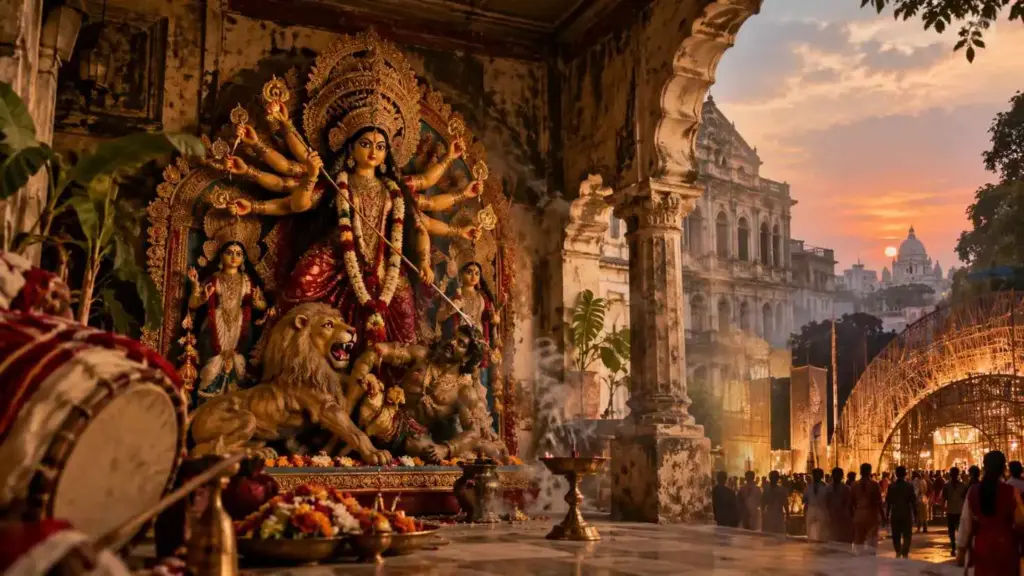
When I think about Durga Puja, I do not see it only as a religious festival. I see a celebration that connects mythology, history, family traditions, art, food and Bengali culture. The origin of Durga Puja is not linked to one single event or one person; its modern form developed gradually through religious traditions, regional customs and social changes.
Durga Puja has both mythological and historical roots.
The mythological foundation comes from the story of Goddess Durga defeating Mahishasura, the buffalo demon, symbolising the victory of good over evil.
Historically, the worship of Durga developed through different traditions across eastern India and became especially prominent in Bengal.
During the 18th and 19th centuries, wealthy Bengali households used elaborate Durga Puja celebrations to demonstrate social status and influence.
Later, community-based celebrations transformed Durga Puja into the large public festival I see across Kolkata and other cities today.
In 2021, Durga Puja in Kolkata was inscribed on UNESCO’s Representative List of the Intangible Cultural Heritage of Humanity. (ICH UNESCO)
What is the historical origin of Durga Puja?
The historical origin of Durga Puja cannot be assigned to one exact year.
The worship of the Goddess has developed over centuries, and the traditions associated with Durga changed as Hindu religious practices evolved in different parts of India.
In Bengal, the history became particularly important because Durga gradually became connected with the cultural identity of Bengali households.
A 2025 historical overview published by The Indian Express notes that the roots of goddess worship in Bengal can be traced to older local and tribal traditions, while Durga entered the Brahmanical religious framework by around the 13th and 14th centuries. (The Indian Express)
This means that when I search for the Durga Puja origin, I should not expect to find one historical founder.
Instead, I need to look at several layers:
- Ancient religious traditions
- The mythology of Durga and Mahishasura
- Regional goddess worship
- The development of Durga worship in Bengal
- Zamindari household celebrations
- Community-based public Puja
- Modern artistic and cultural celebrations
That gradual evolution explains why Durga Puja today is much more than a temple ritual.
What is the mythological origin story of Durga Puja?
The mythological origin of Durga Puja is connected with the battle between Goddess Durga and Mahishasura.
According to Hindu mythology, Mahishasura received a powerful boon that made him extremely difficult for the gods to defeat.
He became increasingly powerful and challenged the gods.
The gods eventually combined their divine energies to create Goddess Durga.
Durga was given weapons by different deities and became the warrior form of divine feminine power.
She fought Mahishasura and eventually defeated him.
This story gives Durga Puja its central spiritual meaning: the triumph of good over evil and divine strength over destructive power.
The mythology also explains why Durga is represented as a powerful warrior riding a lion or tiger and fighting Mahishasura.
For me, this is one of the most important reasons the festival remains relevant even today.
The story is not only about a battle between two characters.
It represents the idea that destructive forces can eventually be overcome through courage, determination and righteousness.
When is Durga Puja celebrated and why does the date change every year?
Durga Puja is generally celebrated during September or October according to the Hindu lunar calendar.
UNESCO describes it as an annual festival celebrated mainly in Kolkata and West Bengal, while also being observed in other parts of India and among Bengali communities around the world. (ICH UNESCO)
The dates therefore change according to the lunar calendar rather than following a fixed Gregorian date.
What is the 2026 Durga Puja date?
For Kolkata in 2026, the important dates include:
| Festival/ritual | 2026 date |
| Mahalaya | October 10 |
| Navratri begins | October 11 |
| Kalparambha | October 17 |
| Akal Bodhon | October 17 |
| Navpatrika Puja | October 18 |
| Durga Ashtami | October 19 |
| Maha Navami | October 19 |
| Bengal Maha Navami | October 20 |
| General Vijayadashami | October 20 |
| Bengal Vijayadashami | October 21 |
These dates can differ depending on the regional calendar and ritual tradition. For Kolkata, the Bengal-specific calendar places Bengal Vijayadashami on October 21, 2026. (Drik Panchang)
So if someone searches for the calendar 2026 Durga Puja date, it is important to specify the location and tradition rather than giving only one date.
What is the significance of Mahalaya in Durga Puja?
Mahalaya marks an important beginning of the Durga Puja season for Bengali families.
It is traditionally associated with invoking Goddess Durga and the beginning of the countdown toward the main Puja days.
One of the most recognisable traditions is listening to Mahishasura Mardini, the famous devotional radio programme associated with Mahalaya morning.
The emotional atmosphere is difficult to explain to someone who has never experienced it.
For many Bengali families, Mahalaya is when Durga Puja starts to feel close.
The streets begin changing.
Pandal construction becomes visible.
New clothes start arriving.
People begin planning their Puja shopping.
Spiritual anticipation becomes part of everyday life.
Who started Durga Puja in Bengal?
There is no historically proven single person who can be called the founder of Durga Puja.
This is one of the biggest misunderstandings surrounding the Durga Puja origin.
One popular story connects the development of Kolkata’s Durga Puja with Raja Nabakrishna Deb of Sovabazar and British administrator Robert Clive after the Battle of Plassey in 1757.
However, historians have questioned this story.
The Indian Express reports that there is no reliable evidence proving that Nabakrishna Deb and Clive had the relationship described in the popular story before 1757, nor firm evidence that the Puja actually took place in that year. (The Indian Express)
This does not mean Sovabazar’s Durga Puja is historically unimportant.
Instead, the story helps explain the larger social environment in which elaborate Durga Puja celebrations became prominent in colonial Bengal.
Powerful zamindars and wealthy merchants increasingly used large celebrations to demonstrate their wealth, influence and social position. (The Indian Express)
So the better answer to “who started Durga Puja?” is:
No single person started Durga Puja. Its modern Bengali form developed gradually through religious, social and cultural changes.
How did Durga Puja become important in old Kolkata?
The history of the old Durga Puja in Kolkata is closely connected with wealthy Bengali households.
During the colonial period, prominent families organised elaborate household Pujas.
These celebrations were not limited to religious rituals.
They also became opportunities for social gatherings, cultural performances and demonstrations of wealth.
The rise of zamindars and merchant communities during British rule played an important role in this transformation.
The grander the celebration, the more visible the family’s social position could become.
This is why some old family Pujas in Kolkata continue to be associated with heritage buildings, traditional rituals and distinctive family customs.
The important point is that modern Durga Puja did not suddenly appear as the giant public festival I see today.
It passed through several stages.
Household worship → aristocratic celebration → community Puja → mass urban festival.
What is the origin story of Durga Puja according to different regions?
Durga worship does not look exactly the same everywhere.
Different regions developed their own rituals, stories and cultural expressions.
| Region | Distinctive connection |
| West Bengal | Elaborate community and household Durga Puja |
| Kolkata | Large artistic pandals, Bonedi Bari traditions and cultural celebrations |
| Bangladesh | Strong Bengali cultural and religious traditions with regional variations |
| Assam | Shakta traditions and regional forms of Goddess worship |
| Odisha | Different regional forms of Durga worship and autumn festivals |
| North India | Durga worship closely connected with Navratri |
| South India | Goddess worship integrated into broader Navratri traditions |
This is why asking for one universal “original Durga Puja” can create confusion.
The central goddess may be the same, but the rituals and cultural meaning can differ.
Is Durga Puja and Navratri the same?
Durga Puja and Navratri are closely related but they are not exactly the same festival experience.
Both are connected with Goddess worship and the autumn Hindu calendar.
However, the traditions vary by region.
In many parts of North and Western India, Navratri focuses strongly on nine nights of Goddess worship, fasting, devotional activities, Garba and Dandiya.
In Bengal, Assam and parts of eastern India, Durga Puja becomes the central celebration, especially during Shashthi, Saptami, Ashtami, Navami and Dashami.
This is why two people can celebrate the same broader religious season but experience completely different rituals.
What are the key differences between original and modern Durga Puja practices?
The biggest difference is the scale and public character of the celebration.
Earlier household Pujas were generally centred around family residences and traditional rituals.
Modern community Puja can involve enormous pandals, themed installations, lighting, artistic sculptures, cultural programmes and large crowds.
UNESCO specifically recognises Durga Puja in Kolkata as a major public expression combining religion, art, craftsmanship and community participation. (ICH UNESCO)
Earlier traditions
- Family-centred worship
- Traditional household rituals
- Limited public participation
- Strong family-specific customs
- Smaller-scale decoration
Modern celebrations
- Community-organised Puja
- Large pandals
- Theme-based artistic installations
- Public cultural programmes
- Extensive lighting and decoration
- Large-scale participation
Yet many essential rituals remain.
That combination of tradition and innovation is one reason Durga Puja continues to evolve without losing its identity.
What is Durga Puja Chandi Path and why is it important?
Chandi Path refers to the recitation of the Devi Mahatmya, a sacred text associated with the worship of the Goddess.
It describes the power and victories of the Goddess, including her battle against powerful demons.
During Durga Puja, Chandi Path is especially significant because it reinforces the spiritual foundation behind the festival.
For someone attending only the public celebrations, it can be easy to focus on pandals, food, clothes and photography.
But the Chandi Path reminds me that the festival has a deeply religious foundation beneath the colourful public celebration.
How has Durga Puja changed from a family festival to a community celebration?
One of the biggest transformations happened when Durga Puja moved beyond wealthy household celebrations and became increasingly community-oriented.
Community participation allowed people from different social backgrounds to take part in the festival.
Over time, Puja committees became responsible for organising the idol, pandal, rituals, lighting and cultural programmes.
This changed the festival from a private family event into a shared urban experience.
Today, Kolkata during Durga Puja almost feels like a different city.
Roads become crowded.
Neighbourhoods compete through artistic pandals.
People travel across the city to see different themes.
Food stalls remain busy late into the night.
Friends and families plan pandal-hopping routes.
This public character is now one of the defining features of the festival.
Why is Durga Puja culturally important today?
Durga Puja is important because it combines religion with art, craftsmanship, community and cultural identity.
UNESCO notes that artisans create clay images using Ganga River clay and that the festival involves large installations, pavilions, traditional Bengali drumming and public participation. (ICH UNESCO)
In 2021, UNESCO officially inscribed Durga Puja in Kolkata on its Representative List of the Intangible Cultural Heritage of Humanity. (UNESCO)
That recognition is significant because Durga Puja is not simply about worshipping an idol.
It supports entire creative ecosystems involving:
- Idol makers
- Artists
- Pandal designers
- Decorators
- Musicians
- Traditional craftsmen
- Food vendors
- Small businesses
- Local communities
This is why the festival has such a strong economic and cultural presence.
What do people wear and do during Durga Puja?
For many people, Durga Puja is also a time for dressing traditionally and spending time with family and friends.
Women often choose sarees, especially during Ashtami and Dashami.
Men commonly wear kurta-pajama, dhoti or other traditional outfits.
If I were preparing a Durga Puja special dress for women, I would choose something comfortable enough for several hours of walking because pandal-hopping usually means spending a lot of time outdoors.
A simple traditional outfit can work better than something uncomfortable or overly complicated.
The same applies to a Durga Puja hairstyle.
A neat bun, braid or open hairstyle can complement a traditional saree without making the look difficult to manage.
The focus is not only fashion.
It is about feeling connected to the atmosphere of the festival.
What are some useful Durga Puja gift ideas?
Choosing a Durga Puja gift becomes easier when I think about the person receiving it.
Some practical ideas include:
- Traditional Bengali sweets
- Sarees or ethnic clothing
- Handmade crafts
- Decorative home items
- Books
- Personalised gifts
- Bengali artwork
- Traditional jewellery
- Festival gift hampers
A thoughtful gift does not have to be expensive.
Something connected with Bengali culture or the person’s interests can make the gift more meaningful.
Why is Durga Puja more than a religious festival?
Durga Puja has developed into a cultural experience that combines faith, history, creativity and community.
The mythology gives the festival its spiritual foundation.
History explains how the celebration developed in Bengal.
Art gives it visual identity.
Music creates its atmosphere.
Food connects families.
Community participation makes it public.
And the emotional idea of Durga returning to her parental home makes the festival deeply personal for many Bengali families.
That combination is what makes the origin and evolution of Durga Puja so interesting.
What should I remember about the origin of Durga Puja?
The simplest way to understand Durga Puja’s origin is to separate mythology from documented history.
Mythologically, Durga Puja celebrates Goddess Durga’s victory over Mahishasura.
Historically, Durga worship developed over a long period and became deeply established in Bengal.
During the colonial period, wealthy households helped make elaborate Durga Puja an important social institution.
Later, community-based celebrations transformed it into the large public festival associated with Kolkata today.
So there is no single date, person or location that completely explains its origin.
Durga Puja is the result of centuries of religious development and cultural evolution.
Frequently Asked Questions About Durga Puja Origin
Is Durga Puja thousands of years old?
The mythology associated with Goddess Durga is ancient, but the modern form of Bengali Durga Puja developed gradually over centuries. It is therefore better to distinguish ancient goddess traditions from the later historical development of the festival.
What is the original story of Durga Puja?
The central mythological story is Goddess Durga’s battle against Mahishasura. Her victory represents the triumph of good over evil and divine power over destructive forces.
Who started Durga Puja in Kolkata?
No single founder can be historically established. The Sovabazar Rajbari tradition associated with Nabakrishna Deb is one of Kolkata’s most famous historical narratives, but the popular 1757 Clive story is disputed by historians. (The Indian Express)
Where did Durga Puja originate?
There is no universally accepted single birthplace for the entire festival. Goddess worship has older and broader roots, while Bengal became one of the most important centres for the development of the Durga Puja tradition seen today.
Is Durga Puja and Navratri the same?
They are closely related autumn Goddess-worship traditions, but their rituals and regional practices differ. Bengali Durga Puja has its own distinctive cultural and ritual identity.
When is Durga Puja in 2026?
In Kolkata, the major Durga Puja period falls in October 2026. Durga Ashtami is October 19, Bengal Maha Navami is October 20, and Bengal Vijayadashami is October 21. (Drik Panchang)
Why is Durga Puja famous in Kolkata?
Kolkata is famous for its large community Pujas, historic household celebrations, artistic pandals, cultural programmes and massive public participation. UNESCO recognised Durga Puja in Kolkata as Intangible Cultural Heritage in 2021. (ICH UNESCO)
What happens during Durga Puja?
People participate in religious rituals, visit pandals, see Durga idols, enjoy cultural programmes, eat traditional food, meet relatives and friends, and celebrate together. The festival concludes with immersion of the idol.
Why is Durga called the mother of the festival?
In Bengali cultural tradition, Durga is often viewed not only as a powerful goddess but also as a daughter returning to her parental home. This emotional interpretation gives the festival its distinctive feeling of homecoming. UNESCO also describes the festival as signifying “home-coming” or a seasonal return to one’s roots. (ICH UNESCO)
Final Thoughts
When I look at the Durga Puja origin, I find that its real story is much richer than a single historical claim.
It begins with ancient ideas about divine feminine power.
It develops through the mythology of Durga and Mahishasura.
It becomes deeply connected with Bengal through centuries of religious and cultural change.
It grows through household and zamindari traditions.
And eventually, it becomes the massive community celebration that millions of people experience today.
That is why Durga Puja continues to feel both ancient and modern at the same time.
Its rituals preserve the past, while its art, themes and community celebrations continue to change every year.