
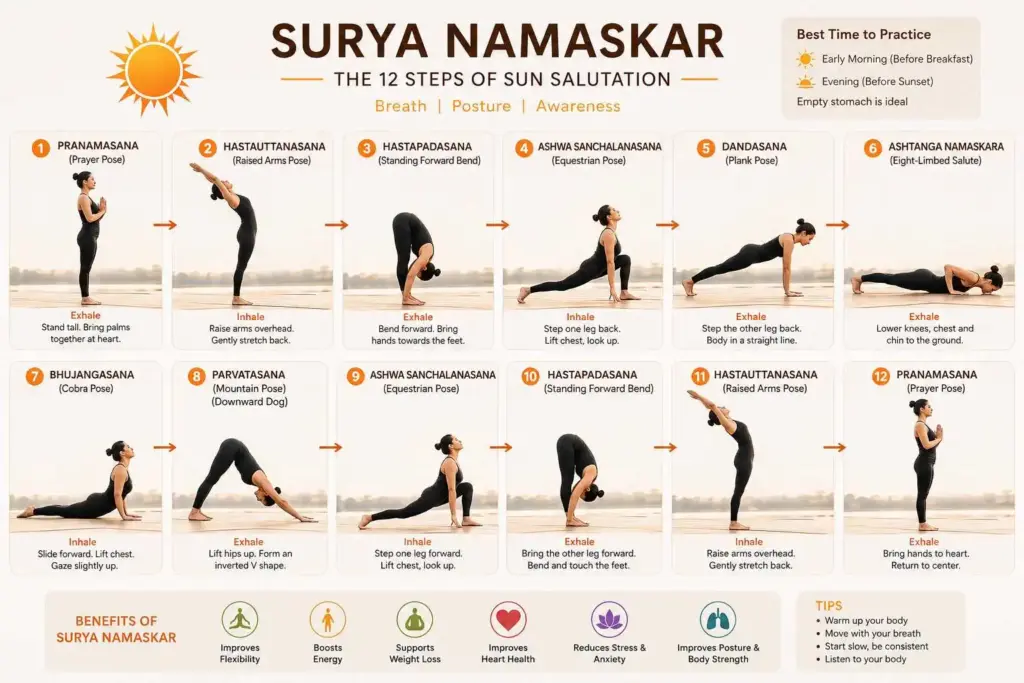
The best time to do Surya Namaskar is usually early morning before breakfast, but consistency matters more than following a fixed clock time. I can also practice it in the evening if my stomach is relatively empty and the intensity suits my body.
Surya Namaskar, also called Sun Salutation, is a flowing sequence of yoga postures coordinated with breathing. I find it useful because it combines stretching, movement, balance and physical effort in one routine. However, many beginners are confused about when to do Surya Namaskar, how many rounds to perform, whether morning is better than evening, and whether it really helps with weight loss.
This article answers those questions from a practical perspective so I can choose a routine that fits my body and lifestyle.
TL;DR: When Should I Do Surya Namaskar?
Early morning before breakfast is my preferred time for Surya Namaskar. If mornings are not practical, I can practice later in the day, provided I allow enough time after meals.
- Best traditional time: Early morning, around sunrise
- For beginners: Start with 2–4 comfortable rounds
- Before food: Preferable for most people
- Evening: Possible if I have allowed enough time after eating
- For weight loss: Consistency matters more than a specific time
- During periods: Gentle practice may be suitable if I feel comfortable
- Breathing: Coordinate each movement with inhalation or exhalation
- For beginners: Focus on technique before increasing the number of rounds
When Is the Best Time to Do Surya Namaskar for Beginners?
For beginners, early morning before breakfast is generally the easiest time to practice Surya Namaskar.
I prefer this timing because my stomach is empty, my mind is relatively free from daily distractions, and I can complete the practice before starting other activities.
Traditional yoga teachings commonly recommend morning practice. The Yoga Institute describes early morning as an ideal time, while Art of Living also recommends practicing around sunrise.
However, I do not think I should stop practicing simply because I cannot wake up at sunrise.
If my work schedule makes morning practice difficult, I can choose another consistent time.
My beginner approach
| Experience | Suggested approach |
| Complete beginner | 2–4 rounds |
| Comfortable with the sequence | 4–6 rounds |
| Regular practitioner | Gradually increase according to ability |
| New to yoga | Focus on breathing and alignment |
| Feeling tired or uncomfortable | Reduce rounds or rest |
Morning before breakfast is an excellent starting point for beginners, but the best time is ultimately the time I can maintain safely and consistently.
What Is the Ideal Time of Day for Daily Practice?
Early morning, particularly around sunrise, is the traditional choice for daily Surya Namaskar.
Morning practice gives me a simple routine: wake up, drink some water if needed, prepare my mat and practice before breakfast.
I also find that practicing early removes the common excuse of being too busy later.
But there is an important difference between traditional timing and scientifically proven superiority. I would not claim that sunrise automatically produces greater health benefits than every other time of day.
My practical rule is simple:
If morning works for me, I choose morning. If it does not, I choose another time that I can maintain regularly.
Sunrise is a traditional and practical time for Surya Namaskar, but consistency is more important than forcing myself into an inconvenient schedule.
Can I Do Surya Namaskar in the Evening?
Yes, I can do Surya Namaskar in the evening.
Morning is commonly recommended, but evening practice can be useful for people who work, study or have other responsibilities in the morning.
I would avoid practicing immediately after dinner because forward bends and abdominal movements can feel uncomfortable on a full stomach.
If I practice in the evening, I prefer a moderate pace. If my goal is relaxation or better sleep, I would avoid an extremely fast and intense session immediately before going to bed.
Surya Namaskar can be performed at different speeds. A faster sequence creates more physical demand, while a slower practice can be used for controlled movement and relaxation.
Evening Surya Namaskar is possible and practical, but I should allow enough time after meals and adjust the intensity according to my energy and sleep schedule.
Are There Specific Times for Weight Loss Benefits?
There is no magic time of day that guarantees greater fat loss from Surya Namaskar.
This is one of the biggest misconceptions I see around Surya Namaskar weight loss.
Surya Namaskar involves repeated movements that can increase energy expenditure. It can therefore contribute to an active lifestyle and weight-management plan.
However, losing body fat depends on the overall relationship between energy intake and expenditure, along with physical activity, sleep and other lifestyle factors.
I would not promise that doing Surya Namaskar at 5 a.m. will automatically burn more fat than doing the same practice later.
Does Surya Namaskar reduce fat?
It can contribute to overall fat loss when combined with an appropriate diet and sufficient physical activity, but it cannot specifically target belly fat.
A 2026 systematic review found promising evidence for Surya Namaskar across physical fitness, physiological measures, psychological well-being and body composition, while also noting differences between studies.
For my weight-loss goal, I would focus on:
- regular practice
- gradual progression
- balanced nutrition
- adequate sleep
- walking or other aerobic activity
- strength training where appropriate
Surya Namaskar can support weight management, but there is no special clock time that independently guarantees fat loss.
What Are the Health Benefits of Doing Surya Namaskar Early Morning vs Evening?
Both morning and evening practice can provide useful physical benefits; the biggest difference is how the practice fits my routine and how intensely I perform it.
Surya Namaskar combines multiple movements into a flowing sequence. Depending on the style and speed, it can involve stretching, muscular engagement, balance, coordination and cardiovascular effort.
Morning practice
Morning Surya Namaskar may help me:
- start my day with movement
- loosen stiffness after sleeping
- establish a consistent routine
- practice before breakfast
- prepare mentally for the day
Evening practice
Evening practice may help me:
- break up a sedentary day
- move after sitting at work
- release physical tension
- transition from work to personal time
- practice slowly before relaxation
I would not say morning is universally better than evening. My body, schedule and practice intensity matter.
Morning practice is convenient and traditional, while evening practice can work well for people with busy mornings. The best option is the one I can practice consistently and comfortably.
How Do Meal Times Affect the Practice Schedule?
I prefer practicing Surya Namaskar on an empty or relatively empty stomach rather than immediately after eating.
The sequence includes forward bends, backward movements and abdominal engagement. A heavy meal can make these movements uncomfortable.
For this reason, I prefer:
Morning: Practice before breakfast.
Afternoon: Allow enough time after lunch.
Evening: Practice before dinner or sufficiently long after an earlier meal.
Traditional yoga guidance also recommends avoiding practice immediately after meals.
I would not become obsessed with counting exact hours. The size of the meal, my digestion and the intensity of my practice all make a difference.
Avoid Surya Namaskar immediately after a heavy meal. Practicing before breakfast or after sufficient digestion time is generally more comfortable.
How Should I Practice Surya Namaskar Correctly?
I should learn the sequence slowly, coordinate movement with breathing and increase the number of rounds only after I can perform the movements comfortably.
Different yoga schools teach slightly different versions of Surya Namaskar. A commonly taught sequence contains 12 positions.
What Are the Surya Namaskar 12 Aasan?
The commonly taught Surya Namaskar 12 aasan are:
- Pranamasana — Prayer Pose
- Hastauttanasana — Raised Arms Pose
- Hastapadasana — Standing Forward Bend
- Ashwa Sanchalanasana — Equestrian Pose
- Dandasana/Plank variation
- Ashtanga Namaskara
- Bhujangasana — Cobra Pose
- Parvatasana/Downward-Facing Dog variation
- Ashwa Sanchalanasana
- Hastapadasana
- Hastauttanasana
- Pranamasana
The exact names and movements can vary between yoga traditions, so I would follow one properly taught sequence instead of mixing several versions.
What Is the Surya Namaskar Inhale Exhale Pattern?
I generally inhale during opening or expansive movements and exhale during forward-folding or contracting movements.
A commonly taught pattern is:
| Movement | Breathing |
| Raise arms | Inhale |
| Forward bend | Exhale |
| Lunge | Inhale |
| Plank/lowering | Exhale |
| Cobra | Inhale |
| Downward-facing position | Exhale |
| Return lunge | Inhale |
| Forward bend | Exhale |
| Raise arms | Inhale |
| Prayer position | Exhale |
The precise instructions can differ between schools.
The important point is that I should avoid unnecessarily holding my breath.
Learn one consistent 12-position sequence, coordinate the movement with breathing and prioritize control over speed.
How Many Times Do Surya Namaskar Need to Be Done?
There is no universal number of rounds that everyone needs to perform.
For a beginner, I would rather complete four technically controlled rounds than rush through 20 rounds with poor alignment.
I can gradually increase the number as my body becomes accustomed to the practice.
A practical progression
Beginner: 2–4 rounds
Regular practitioner: 4–12 rounds
Advanced: Higher volume only when technique and recovery support it
Some practitioners perform 24, 54 or 108 rounds on special occasions. I would not treat these numbers as daily requirements.
Start with a manageable number of rounds and increase gradually. Good technique and consistent practice matter more than a high number.
When Is It Advisable to Avoid This Practice?
I should modify or avoid Surya Namaskar when I have a medical condition, injury or symptom that makes the movements unsafe or painful.
Extra caution may be necessary with certain cardiovascular conditions, uncontrolled blood pressure, acute injuries, severe joint problems and during pregnancy.
If I experience dizziness, chest pain, unusual shortness of breath or severe pain, I should stop rather than trying to complete the planned number of rounds.
The Yoga Institute also advises caution for people with certain health conditions. I should not force Surya Namaskar through pain or concerning symptoms. Medical or qualified professional guidance is appropriate when a health condition may affect exercise safety.
Can I Do Surya Namaskar During Periods?
Yes, I may be able to practice gentle Surya Namaskar during periods if I feel comfortable.
I would not use the same intensity every day of my menstrual cycle.
If I have cramps, heavy bleeding, dizziness or unusual fatigue, I may reduce the number of rounds or take a rest day.
The goal is not to prove that I can complete a fixed number of rounds. The goal is to listen to my body.
Gentle Surya Namaskar can be considered during periods when I feel well, but I should reduce intensity or rest when symptoms are significant.
Is Surya Namaskar Useful for Weight Gain?
Surya Namaskar can support general fitness, but it should not be my main strategy for gaining weight.
If I want healthy weight gain, I need adequate nutrition and, especially for muscle gain, progressive resistance training.
Doing very large numbers of fast Surya Namaskar rounds can increase energy expenditure, which may make it harder to maintain a calorie surplus.
I would therefore use a moderate practice for mobility and conditioning while focusing on nutrition and strength training.
Surya Namaskar can complement a weight-gain routine, but nutrition and resistance training are more important for increasing healthy body mass.
What Are the Main Surya Namaskar Health Benefits?
Surya Namaskar can support flexibility, muscular conditioning, coordination, mobility and general physical fitness.
Potential Surya Namaskar health benefits include:
- improved flexibility
- improved mobility
- muscular engagement
- better coordination
- balance development
- increased physical activity
- cardiovascular conditioning
- support for healthy body composition
- stress-management benefits
Research reviews have reported promising results, but the quality and design of studies vary, so I would avoid treating Surya Namaskar as a cure for disease.
Surya Namaskar is best understood as a whole-body movement practice that can contribute to physical fitness and well-being rather than as a treatment for specific diseases.
What Surya Namaskar Variations Can I Try?
I can modify Surya Namaskar according to my fitness level, flexibility and physical limitations.
Useful Surya Namaskar variations include:
- slower beginner sequences
- knee-supported versions
- modified plank
- reduced-depth forward bends
- gentler backbends
- slower meditative practice
- faster fitness-oriented practice
I would learn the basic sequence first. Once I understand the movements, modifications become easier to apply.
Surya Namaskar variations can make the practice more accessible and adaptable, but I should prioritize safe movement over complexity or speed.
Who Popularised Surya Namaskar in Modern India?
Bhavanrao Shrinivasrao Pant Pratinidhi, the Raja of Aundh, played an important role in popularising and systematising Surya Namaskar in modern India.
Historical research connects him with the promotion of Surya Namaskar through physical education and his 1928 publication on the practice.
However, I would not describe him as the sole inventor because the historical development of Sun Salutation is more complicated and includes earlier traditions.
This distinction between popularising and inventing is important when discussing the history of Surya Namaskar.
Pant Pratinidhi is strongly associated with the modern popularisation and systematisation of Surya Namaskar, while its deeper history has multiple influences.
What Should I Look for in a Surya Namaskar Photo Step by Step?
A useful Surya Namaskar photo step by step should clearly show body position, hand and foot placement, movement direction and breathing cues.
When I use an image to learn the sequence, I check:
- Is the whole body visible?
- Are the hands and feet clearly positioned?
- Is the spine position understandable?
- Are the pose names included?
- Is the transition between poses clear?
- Does it explain breathing?
A photograph can help me remember the sequence, but it cannot always show the subtle alignment details that an instructor can correct. A good step-by-step Surya Namaskar image should teach the sequence clearly instead of simply displaying attractive yoga poses.
How Can I Practice Surya Namaskar for Better Sleep?
For better sleep, I would choose a slower and gentler evening practice rather than a fast, intense session immediately before bed.
If I notice that evening Surya Namaskar makes me more energetic, I would move the practice earlier.
If it helps me relax, I can combine slow movements with controlled breathing and a short relaxation period.
A gentle evening sequence may fit a sleep-focused routine better than an intense workout immediately before bedtime.
What Is the Best Time to Do Surya Namaskar for Beginners?
Early morning before breakfast is a practical choice for beginners. It allows me to practice before meals and daily responsibilities, but another consistent time is also acceptable.
Frequently Asked Questions
Can I Do Surya Namaskar in the Evening?
Yes. I can practice in the evening if I have allowed sufficient time after eating and adjust the intensity according to my energy and sleep.
How Many Times Do Surya Namaskar Should I Do Daily?
I can start with 2–4 rounds and gradually increase. There is no universal number that every person must perform.
Does Surya Namaskar Reduce Fat?
It can contribute to overall fat loss as part of an active lifestyle, but it cannot specifically target belly fat. I would combine it with appropriate nutrition and other physical activity.
How Many Mantras Are There in Surya Namaskar?
A commonly taught version has 12 mantras. Each mantra corresponds to one of the 12 positions in the sequence.
Can I Do Surya Namaskar During Periods?
Yes, if I feel comfortable. I would reduce the intensity or rest if I experience significant cramps, heavy bleeding, dizziness or unusual fatigue.
Is Surya Namaskar Good for Weight Gain?
It can support general fitness but is not a primary weight-gain method. For healthy weight gain, I would focus more on adequate nutrition and resistance training.
Should I Do Surya Namaskar Before or After Breakfast?
Before breakfast is generally more comfortable for me. Practicing immediately after eating can make bending and abdominal movements uncomfortable.
What Is the Surya Namaskar Breathing Pattern?
I generally inhale during opening movements and exhale during forward-folding movements. The exact pattern can differ between yoga traditions.
Is Surya Namaskar Enough as My Only Exercise?
It can be a useful part of my exercise routine, but I would not rely on it alone for every fitness goal. I can combine it with walking, aerobic exercise and strength training according to my needs.
Final Thoughts
When I ask “when to do Surya Namaskar,” I do not need to search for a magical hour. Morning before breakfast is an excellent choice, but a consistent routine that fits my life is more useful than a perfect schedule I cannot maintain.
I would begin with a few rounds, learn the Surya Namaskar 12 aasan, coordinate the inhale and exhale pattern, and gradually increase the practice.
For weight loss, I would focus on the complete lifestyle rather than expecting Surya Namaskar alone to reduce fat.
For periods, injuries or medical conditions, I would adjust the practice according to how my body responds.
The biggest lesson for me is simple: practice regularly, breathe naturally, move with control and respect my body’s limits.