
Hatha Yoga is a traditional form of yoga that combines physical postures, breathing practices and focused awareness. In modern yoga classes, Hatha usually means a slower, controlled practice where I hold postures, coordinate my breathing and pay attention to my body rather than moving quickly from one pose to another.
If I am searching for what Hatha Yoga means, I am probably looking for more than a dictionary definition. I may also want to know what Hatha Yoga focuses on, what happens during a session, whether it is suitable for beginners, what its benefits are and how it differs from styles such as Ashtanga and Iyengar.
This article answers those questions in one place.
What is Hatha Yoga?
Hatha Yoga is a traditional yoga system that uses physical practices, breathing and concentration to develop greater awareness of the body and mind.
In modern classes, Hatha Yoga generally involves performing postures at a measured pace, holding them for several breaths and moving between them with control.
I do not need to be highly flexible to practice Hatha Yoga.
It can help me work on flexibility, strength, balance, mobility, body awareness, relaxation and concentration.
The important distinction is that traditional Hatha Yoga is broader than the modern studio meaning of a slow yoga class.
What does Hatha Yoga mean in simple terms?
In simple terms, Hatha Yoga means practicing yoga through the body and breath while maintaining awareness and control.
When I first hear the term Hatha Yoga, I might think it simply means slow stretching. That explanation is convenient, but it does not fully describe the practice.
Historically, Hatha Yoga developed in India as a system of physical and subtle-body practices. Modern yoga classes use the term differently and generally emphasize physical postures, breathing and relaxation.
So, if someone asks me what does Hatha Yoga mean, I would explain it as a practice that brings together:
- Physical postures or asana
- Breath regulation or pranayama
- Concentration and awareness
- Relaxation
- In traditional contexts, additional practices such as mudra and bandha
The word Hatha is also frequently explained as a combination of “ha,” meaning Sun, and “tha,” meaning Moon. I would be careful about presenting this as the only meaning because the historical development and interpretation of the Sanskrit term are more complex.
For a modern practitioner, the most useful understanding is that Hatha Yoga provides a deliberate way to work with the body, breath and attention.
Hatha Yoga is a traditional yoga practice involving the body, breath and focused awareness. Modern Hatha classes generally use controlled postures and breathing rather than rapid movement.
What are the key elements of Hatha Yoga practice?
The answer to what Hatha Yoga focuses on becomes clearer when I understand its main elements.
Asana refers to physical postures. These can include standing, seated, balancing, twisting, strengthening and relaxing positions.
Pranayama refers to conscious breathing practices. Rather than allowing my breathing to become automatic, I learn to observe and regulate it.
Concentration helps me stay mentally present. While holding a posture, I can pay attention to my breathing, alignment, muscle engagement and physical sensations.
Relaxation gives my body and mind an opportunity to settle after physical practice.
This is why I would not describe Hatha Yoga as simply a stretching workout. The physical posture is only one part of the broader practice.
The key elements of Hatha Yoga include asana, pranayama, concentration and relaxation. Traditional Hatha Yoga can also include practices such as mudras and bandhas.
What are the benefits of practicing Hatha Yoga regularly?
If I ask what is Hatha Yoga and its benefits, the answer includes both physical and mental aspects.
Regular practice can support flexibility and mobility because I repeatedly move my joints and muscles through controlled ranges of motion.
It can also develop strength. Many Hatha postures require me to support, stabilize or control my body.
Hatha Yoga can improve balance and body awareness because I have to pay attention to how I position my body.
The breathing and concentration components can also support relaxation and mental focus.
I would not describe Hatha Yoga as a cure for medical conditions. Instead, I see it as a physical and mindful practice that can complement a healthy lifestyle.
For example, if I spend most of my day sitting at a desk, a regular Hatha practice can give me dedicated time to move, stretch, strengthen and become more aware of my posture and breathing.
Regular Hatha Yoga can support flexibility, strength, balance, mobility, body awareness, relaxation and concentration when practiced consistently and appropriately.
How Does Hatha Yoga Differ From Other Types of Yoga Styles?
One reason people become confused about Hatha Yoga is that the term can describe both a historical yoga tradition and a modern yoga class format.
In a modern yoga studio, Hatha Yoga is generally slower and more deliberate than many flow-based styles. It often focuses on holding postures, coordinating movement with breathing, and developing body awareness.
| Yoga Style | Main Emphasis | Typical Pace |
| Hatha Yoga | Postures, breathing, and awareness | Slow to moderate |
| Ashtanga Yoga | Structured sequence and physical intensity | Moderate to fast |
| Iyengar Yoga | Precision, alignment, and props | Controlled |
| Vinyasa Yoga | Continuous movement with breath | Moderate to fast |
| Yin Yoga | Longer-held passive positions | Slow |
| Restorative Yoga | Supported relaxation and deep rest | Very slow |
In simple terms: Hatha Yoga can be a good choice if you prefer a more controlled practice that gives you time to focus on posture, breathing, and awareness rather than continuously moving from one pose to another.
What is the difference between Hatha Yoga and Ashtanga Yoga?
Hatha Yoga generally gives me more time to focus on individual postures, while Ashtanga follows a structured sequence and can be more physically demanding.
In a Hatha class, I may hold a pose for several breaths before moving to another.
Ashtanga traditionally follows established sequences, with a stronger emphasis on consistency, stamina and physical discipline.
That does not mean Hatha is always easy or Ashtanga is always difficult. The actual experience depends on the teacher, class level and how I practice.
What is the difference between Hatha Yoga and Iyengar Yoga?
Both can emphasize controlled movement and alignment, but Iyengar Yoga places particularly strong emphasis on precise alignment, detailed instruction and the use of props.
A general Hatha class may use blocks and straps, but props are especially central to Iyengar methodology.
So, if I want a class with detailed attention to alignment and systematic use of props, Iyengar may feel different from a general Hatha class.
Modern Hatha Yoga is generally slower and more controlled than Vinyasa, less sequence-driven than Ashtanga and broader than Iyengar, which has a particularly strong focus on alignment and props.
What is the history and origin of Hatha Yoga?
Hatha Yoga has roots that go much deeper than the modern yoga class.
The Hatha Yoga Project at SOAS University describes Hatha Yoga as developing within diverse ascetic traditions in medieval India. Historical research identifies important Hatha-related texts from around the second millennium CE.
The Amṛtasiddhi, associated with the 11th century, is one important early Sanskrit source associated with distinctive Hatha practices.
The Haṭhapradīpikā, traditionally attributed to Svātmārāma and generally dated to the early 15th century, became one of the best-known texts associated with Hatha Yoga.
These traditions included practices involving physical postures, breathing, seals, energy practices and other techniques.
Modern Hatha classes have evolved considerably from these historical systems.
That distinction matters because when I ask “Hatha Yoga, what is it?”, the answer changes depending on whether I am talking about historical Hatha Yoga or a modern yoga-studio class.
Hatha Yoga developed in medieval India through several traditions and texts. Modern Hatha classes represent a contemporary expression of a much broader historical yoga system.
This article explains who Patanjali Maharishi was, his connection with yoga, his major contribution to yoga philosophy, and his lasting legacy. It gives readers historical and foundational context before they explore different yoga practices.
What are the common breathing techniques used in Hatha Yoga?
Breathing is an important part of Hatha Yoga because I do not simply move my body; I also learn to pay attention to how I breathe.
Nadi Shodhana, commonly known as alternate-nostril breathing, involves controlled breathing through alternating nostrils.
Ujjayi breathing uses a gentle narrowing of the throat to create a soft, controlled sound during breathing.
Bhramari involves a gentle humming sound during exhalation and is commonly used as a calming breathing practice.
The purpose is not to force myself to take extremely deep breaths.
I should practice comfortably and stop if I feel dizzy, uncomfortable or unwell.
Common Hatha Yoga breathing practices include Nadi Shodhana, Ujjayi and Bhramari. These practices develop conscious breathing and concentration alongside physical practice.
How does Hatha Yoga help with stress management and mental clarity?
Hatha Yoga can give me an opportunity to slow down and focus on one thing at a time.
When I hold a posture, I can pay attention to my breathing, physical sensations and alignment instead of constantly switching between thoughts and activities.
For example, after a stressful day, I may spend 20 minutes moving through simple Hatha postures rather than immediately going back to my phone or work.
My thoughts may not disappear.
Instead, I practice bringing my attention back to my breathing and movement whenever my mind wanders.
That repeated act of returning my attention can make the practice mentally engaging as well as physically beneficial.
Hatha Yoga can support stress management and mental clarity by combining controlled movement, breathing and focused attention in a slower practice environment.
What is Hatha Yoga exercises for beginners?
When I search for what is Hatha Yoga exercises, I am usually looking for examples of the postures included in the practice.
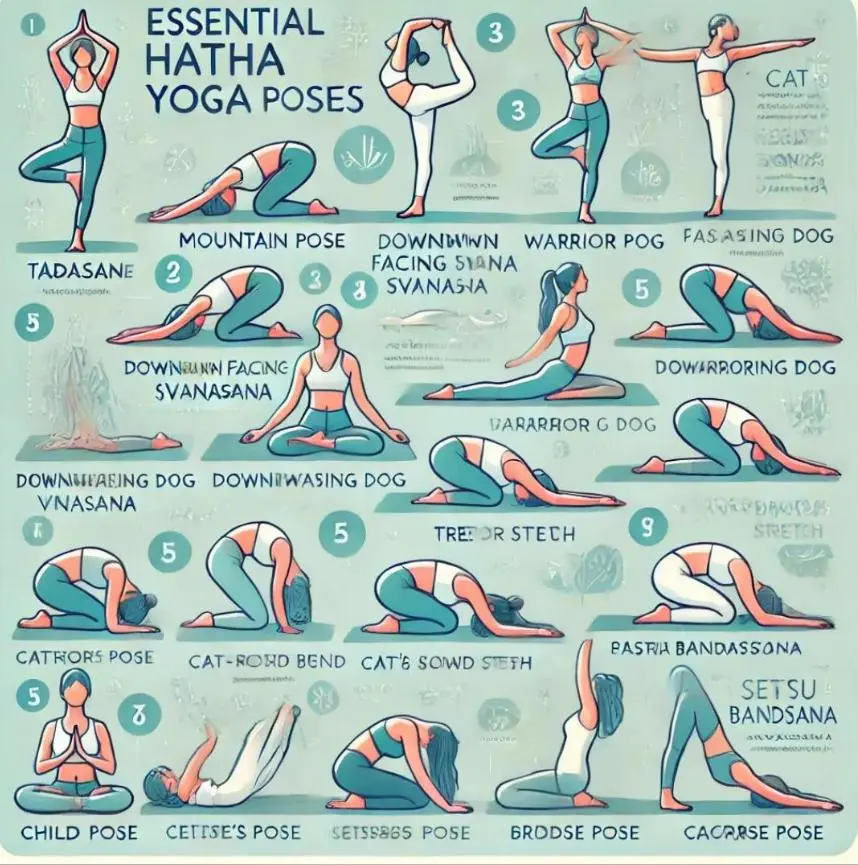
Some common beginner-friendly postures include:
Tadasana
Mountain Pose helps me develop awareness of standing alignment and balance.
Balasana
Child’s Pose provides a gentle resting position and can help me relax between movements.
Bhujangasana
Cobra Pose involves controlled spinal extension. I should avoid forcing the movement into my lower back.
Trikonasana
Triangle Pose works on balance, mobility and body positioning.
Vajrasana
Vajrasana is a seated posture that can be used during breathing or meditation practices.
Sukhasana
Sukhasana provides a simple seated position for breathing and concentration.
Savasana
Savasana is generally practiced toward the end of a session for relaxation.
The important point is that I do not need to perform advanced poses to practice Hatha Yoga effectively.
Common Hatha Yoga exercises include standing, seated, balancing, stretching and relaxation postures. Beginners should focus on comfortable movement, breathing and control rather than advanced flexibility.
What is gentle Hatha Yoga?
Gentle Hatha Yoga is a slower, lower-intensity approach to Hatha practice that uses simpler postures, controlled transitions and modifications.
It can be suitable for someone who is new to yoga or prefers not to perform fast or physically demanding sequences.
Gentle does not necessarily mean ineffective.
I can still work on mobility, balance, breathing, posture and body awareness without pushing myself into challenging positions.
The main difference is intensity and pace.
If I have an injury, significant physical limitation or medical condition, I should seek appropriate professional guidance before beginning a new exercise routine.
Gentle Hatha Yoga uses slower movements, simpler postures and more modifications. It can be an approachable option for beginners and people who prefer lower-intensity yoga.
What is Hatha Yoga good for in everyday life?
So, what is Hatha Yoga good for?
I would say its biggest value is that it combines movement with awareness.
It can help me develop:
- Flexibility
- Strength
- Balance
- Mobility
- Body awareness
- Breathing awareness
- Relaxation
- Concentration
It can also provide a structured form of physical activity without requiring me to move at a fast pace.
I do not need to practice for an hour every day.
A consistent, manageable practice can be more realistic than an intense routine that I cannot maintain.
This is also why Hatha Yoga can work well as a foundation for people who later want to explore other yoga styles.
Hatha Yoga can support everyday physical and mental wellbeing by combining flexibility, strength, balance, breathing, relaxation and focused awareness.
Frequently Asked Questions
What does Hatha Yoga mean in simple terms?
Hatha Yoga means a yoga practice that works with the body, breath and focused awareness.
In modern classes, I usually practice physical postures at a controlled pace while coordinating them with breathing.
For example, rather than quickly moving through several poses, I may stay in one posture for several breaths and pay attention to my alignment.
What are the benefits of regular Hatha Yoga sessions for beginners?
Regular Hatha Yoga can help beginners develop flexibility, strength, balance, mobility and body awareness.
When I practice consistently, I can become more familiar with my body and learn how to coordinate breathing with movement.
I do not need to start with difficult poses.
What are the recommended props for enhancing Hatha Yoga practice?
A yoga mat, blocks, strap, blanket and bolster are useful Hatha Yoga props.
I would not buy every prop immediately.
A mat is usually enough to start, while blocks and straps can help me modify poses according to my flexibility.
For example, if I cannot comfortably reach the floor in Triangle Pose, a block can bring the floor closer instead of forcing my body to reach farther.
Can Hatha Yoga programs focus on flexibility and strength?
Yes, Hatha Yoga can be adapted to emphasize flexibility, strength or a combination of both.
For flexibility, I can spend more time with controlled mobility and stretching postures.
For strength, I can include standing poses, balances and weight-bearing positions.
The important principle is gradual progression rather than forcing my body.
What are Hatha Yoga programs designed for specific health goals?
Hatha Yoga can be adapted for general wellness goals, but I should not treat it as a replacement for medical treatment.
For example, I might choose a gentle practice when my goal is relaxation or a more active practice when I want to develop strength and mobility.
If I have a diagnosed condition or injury, I should seek appropriate professional advice before choosing a specialized yoga routine.
If you want to understand how yoga can be adapted for specific physical and wellness needs, explore therapeutic yoga and its benefits.
Conclusion: What Is Hatha Yoga and What Does It Mean?
If I have to give a clear answer to what Hatha Yoga means, I would describe it as a traditional yoga practice that combines physical postures, breathing and focused awareness.
Modern Hatha Yoga classes usually move at a slower and more controlled pace, giving me time to understand each posture and connect movement with breathing.
It can support flexibility, strength, balance, mobility, relaxation and concentration.
Most importantly, I do not need to be flexible, athletic or experienced to begin.
I can start with simple postures, comfortable breathing and consistent practice.
Once I understand what Hatha Yoga is, I can also understand why it has remained an important part of yoga practice while continuing to evolve in the modern world.
:::